
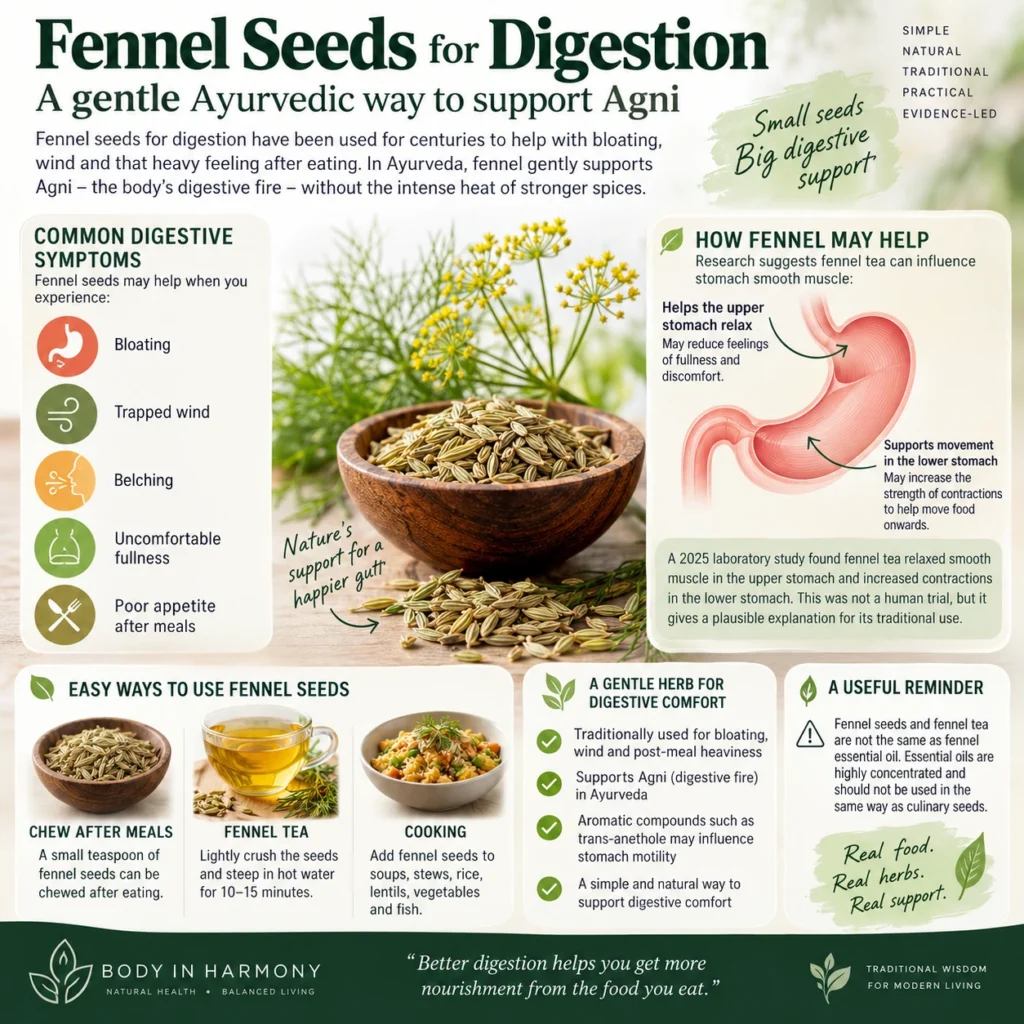
Fennel Seeds for Digestion: A Gentle Ayurvedic Way to Support Agni
Fennel seeds have traditionally been used for bloating, wind and that heavy feeling after eating. In Ayurveda, fennel is used to gently support Agni — digestive fire — without the intense heat of spices such as ginger or black pepper.
Modern research gives us an interesting reason why this old practice may make sense. Fennel contains aromatic compounds, particularly trans-anethole, and research suggests fennel tea can influence the smooth muscle responsible for movement within the stomach.
🔥 Heavy Stomach After Eating?-Fennel Seeds for Digestion
When food seems to sit heavily after a meal, you might notice:
- Bloating
- Trapped wind
- Belching
- Uncomfortable fullness
- Poor appetite for the next meal
Ayurveda considers these sorts of digestive patterns partly through Agni, the body’s capacity to digest and transform food.
If you’re unfamiliar with the concept, I’ve explained it properly in Agni and Ama in Ayurveda: Digestion and Balance.
Agni isn’t another name for stomach acid or metabolism. It’s an Ayurvedic framework for understanding digestion.
🌿 Why Might Fennel Help Digestion?
Fennel Seeds for Digestion. Fennel (Foeniculum vulgare) is traditionally classed as a carminative — an aromatic herb used for gas, bloating and digestive discomfort.
One reason may involve smooth muscle.
The stomach contains smooth muscle that automatically contracts and relaxes to accommodate food, mix it and gradually move it towards the small intestine.
Fennel’s aromatic compounds appear to influence this muscular activity.
🔬 Fennel Seeds For Digestion-What Does the Research Show?
A particularly interesting 2025 study examined fennel tea and smooth muscle from different areas of the stomach.
Researchers found that fennel tea:
- Relaxed smooth muscle in the upper and central stomach.
- Increased the strength of contractions in the lower stomach, or antrum.
- Appeared to influence calcium signalling involved in muscle contraction.
That combination could help explain why fennel has traditionally been used when digestion feels uncomfortable or sluggish.
There is an important limitation. This was laboratory research using guinea-pig stomach tissue, not a human clinical trial.
So it doesn’t prove that fennel tea treats slow digestion in people. What it does provide is a plausible mechanism that supports further investigation.
You can read the research here: Fennel Tea Has a Region-Specific Effect on the Motility of the Stomach — PubMed Central.
☕ Simple Ways to Use Fennel
You don’t need an expensive extract.
For everyday culinary use, fennel can be:
- Chewed after a meal — crushing the seeds releases their aromatic oils.
- Made into tea — lightly crush the seeds and steep them in hot water.
- Added to food — fennel works well with lentils, rice, vegetables, soups, stews and fish.
The 2025 study prepared fennel tea using 2.5 g of seed in 150 ml boiling water for 15 minutes. That’s useful context, but it shouldn’t be interpreted as a clinically proven dose for digestive problems.
🍽️ Poor Appetite and Feeling Too Full
This is where fennel becomes particularly interesting for people trying to rebuild their weight.
Fennel doesn’t cause weight gain.
But if someone needs more nourishment and every meal leaves them bloated and uncomfortably full, simply telling them to eat more calories isn’t particularly useful.
Digestive comfort matters.
Reducing the discomfort surrounding meals may make eating regularly easier, which is why herbs traditionally used around digestion can have a place within a much broader nutritional strategy.
⚠️ Seed, Tea and Essential Oil Are Different
Fennel seed used in food or tea shouldn’t be confused with concentrated fennel essential oil.
Essential oils contain much higher concentrations of volatile plant compounds. More concentrated does not automatically mean more beneficial.
For ordinary digestive use, I favour the simple traditional approach: food, crushed fennel seed or fennel tea rather than jumping immediately to concentrated extracts.
🌱 My Practitioner View
Fennel is a good example of where traditional herbal practice and modern research can have a sensible conversation.
Ayurveda has used fennel around digestion for generations. Modern laboratory research now suggests its compounds can influence stomach smooth-muscle activity.
That doesn’t prove every traditional claim about fennel.
But for someone experiencing occasional bloating, wind or heaviness after eating, fennel remains a simple culinary herb with a credible traditional history and an increasingly interesting physiological explanation.