
🔥 Agni and Ama in Ayurveda: How Digestion and Balance Connect
Understanding Agni and Ama in Ayurveda can sound complicated when you first meet the terminology.
Strip away the Sanskrit, though, and the basic principle is straightforward.
We eat food, the body has to digest and transform it, and Ayurveda places great importance on how well that process is working.
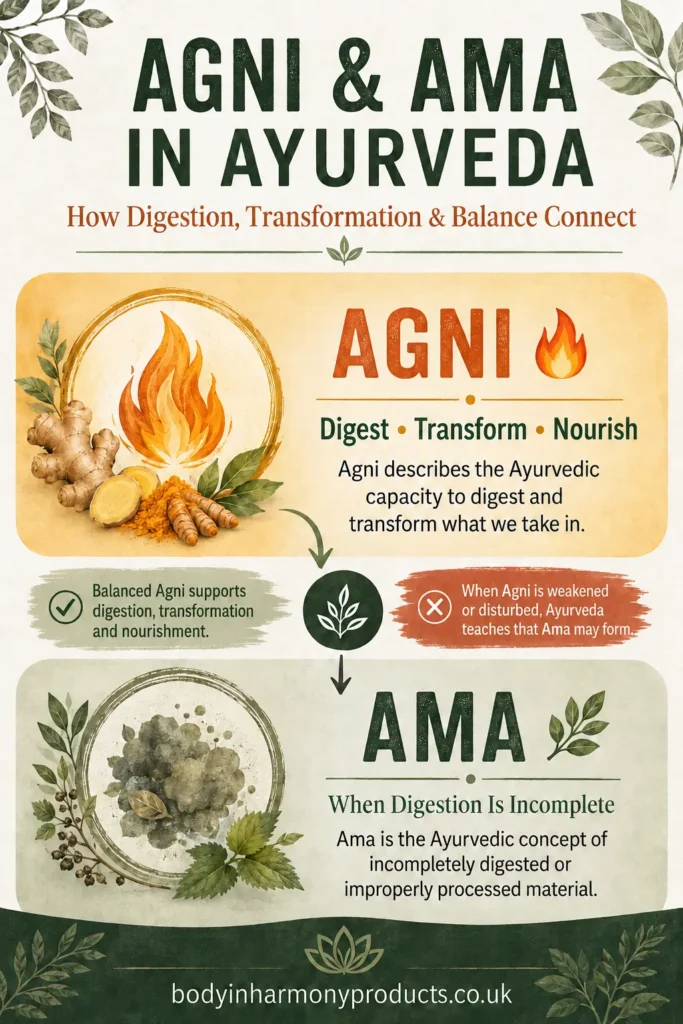
Agni describes our capacity for digestion and transformation.
Ama is the Ayurvedic concept associated with incomplete or disturbed digestion and metabolism.
They are closely connected, but they are not the same thing.
🔥 What Is Agni in Ayurveda?
Agni is usually translated as digestive fire, although Ayurveda uses the term more broadly than simply digestion in the stomach.
It describes the processes involved in digesting, transforming and assimilating what we take into the body.
Food can contain all the protein, vitamins and minerals in the world, but the body still has to break that food down and make use of it.
When Agni is considered balanced, Ayurveda teaches that food is properly transformed so that its useful parts can nourish the body while waste can be eliminated.
A simple way to picture it is:
Food → digestion and transformation → nourishment and waste
This is where my own background in diet and nutrition helped Ayurveda click into place.
Nutrition teaches us to look at what food contains. Ayurveda also asks us to look at the person eating it and how well their digestive system is coping.
I have put together a FREE guide to the basics of Ayurveda that you will find beneficial. Just put your email into the box below and I will send it straight to your inbox.
🌿 What Is Ama?
This brings us to the other half of Agni and Ama in Ayurveda.
Ama is often described online simply as “toxins”.
That is a bit too vague.
Within traditional Ayurveda, Ama is associated with incomplete or impaired digestion and transformation.
Classical Ayurvedic explanations do not restrict Ama entirely to undigested food sitting in the stomach. The concept can also relate to disturbed metabolic processes elsewhere in the body.
A useful academic review describes Ama as a key Ayurvedic concept involving impaired digestion and metabolism rather than one single identifiable substance.
You can read the full review here:
Critical Review and Validation of the Concept of Ama
So the simplest way to understand the relationship is:
Balanced Agni → effective transformation
Disturbed Agni → incomplete transformation → formation of Ama
That is the traditional Ayurvedic model.
🔄 How Are Agni and Ama Connected?
Think about eating exactly the same meal on two different days.
One day you are relaxed, properly hungry and eating slowly.
Another day you are exhausted, stressed, rushing your food and barely paying attention to it.
The ingredients may be identical, but your experience afterwards can be completely different.
That is one reason Ayurveda does not look at food in isolation.
It considers appetite, digestion, constitution, lifestyle, season and your current state of balance.
Research discussing the physiological concept of Agni describes it in relation to digestion, absorption, assimilation and transformation. Traditional Ayurveda also recognises several forms and functional states of Agni rather than treating digestion as something that works identically all the time.
You can read that research here:
⚖️ Healthy Food Is Only Part of the Picture
This is where Agni and Ama in Ayurveda become particularly useful ideas.
We spend a lot of time asking whether a food is healthy.
Ayurveda asks another question:
How does that food work for this particular person?
Two people can eat the same meal and feel completely different afterwards.
Your natural constitution, known as Prakriti, forms part of that picture.
Your current state of balance, called Vikriti, matters as well.
Vata, Pitta and Kapha may influence digestive tendencies, while stress, sleep, activity, climate and eating habits can change how digestion feels from one day to another.
That does not mean analysing every mouthful.
It means paying attention.
Are you genuinely hungry before eating?
Do you usually feel comfortable afterwards?
Do certain meals consistently leave you bloated, heavy or burning?
Those observations are useful.
🍲 Supporting Agni Through Everyday Habits
You do not need to turn the kitchen upside down to start applying this idea.
Ayurvedic eating habits are often remarkably simple.
- Eat when you have a genuine appetite.
- Sit down and pay attention to the meal.
- Chew properly rather than rushing.
- Avoid regularly overeating.
- Give the previous meal time to digest.
- Choose foods that suit your current digestion.
- Keep regular movement and sleep in the picture.
None of that requires a cupboard full of exotic powders.
As practitioners trained in Ayurveda and diet and nutrition, and as members of the CMA, this is where we find the two approaches sit comfortably together.
Food quality matters.
So does digestion, appetite, routine and the individual eating the food.
Herbs and spices can also form part of this approach. Fennel seeds are traditionally used to support digestion, particularly when meals leave you feeling bloated, heavy or full. Modern research is also beginning to uncover how fennel may influence stomach movement. I look at the traditional use, the mechanism and the evidence in Fennel Seeds for Digestion: A Gentle Ayurvedic Way to Support Agni.
🔬 Agni and Ama: Ayurveda or Modern Science?
It is important not to muddle the two.
Agni and Ama are traditional Ayurvedic concepts. They are not modern medical diagnoses or measurable substances with direct biomedical equivalents.
Researchers studying Ayurveda have explored possible relationships between these traditional ideas and digestion, metabolism, inflammation and other biological processes.
However, that does not mean Ama can simply be renamed as “toxins”, inflammation or poor gut bacteria.
Those are modern biological terms with their own definitions.
The better approach is to understand Agni and Ama within Ayurveda first, then look at where modern research may find interesting similarities.
That keeps the traditional system intact without making claims the research cannot support.
🌿 Where to Go Next
Once you understand Agni and Ama in Ayurveda, a lot of the wider system becomes easier to follow.
Agni is about digestion and transformation.
Ama describes what Ayurveda believes may arise when those processes become impaired.
From there, you can start looking at how Vata, Pitta, Kapha, food, routine and constitution influence digestive balance.
If you are new to these ideas, continue with our Beginner’s Guide to Ayurveda from Body in Harmony Products.
You can also type bihp.co.uk into your browser.