
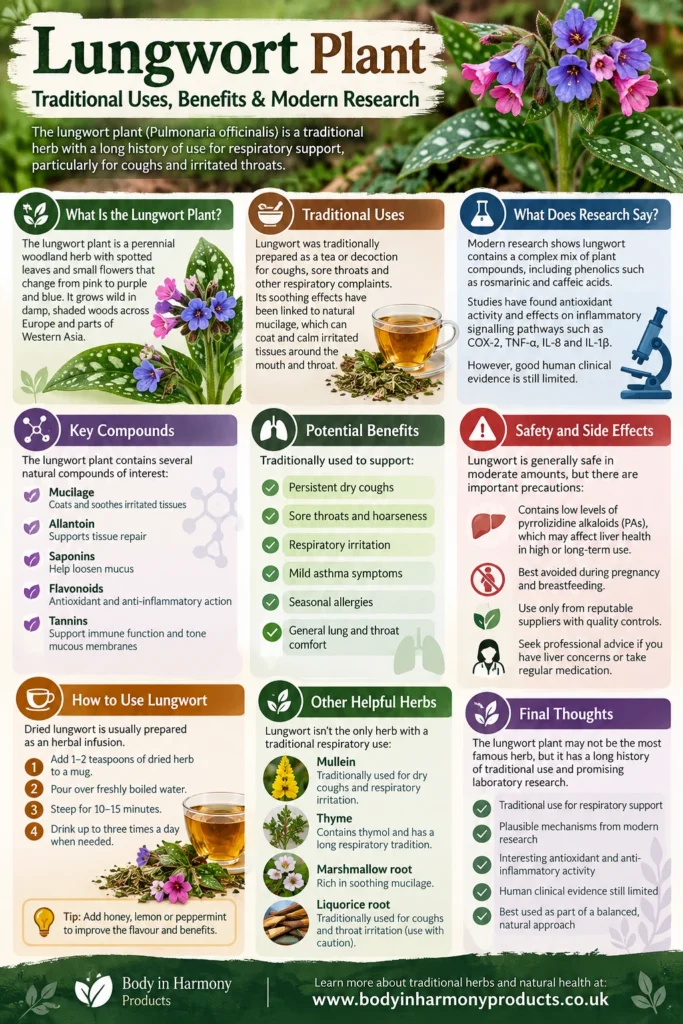
🌿 Lungwort Plant: Traditional Uses, Benefits & Modern Research
The lungwort plant (Pulmonaria officinalis) has been used in European herbal traditions for centuries, particularly for coughs, irritated throats and respiratory complaints.
As a nutritionist and Ayurveda herbalist, I find lungwort interesting because traditional use and modern research meet here, but they don’t completely agree. Its plant chemistry provides some plausible mechanisms, while good human clinical evidence remains limited.
🌸 What Is the Lungwort Plant?
The lungwort plant is a perennial woodland herb recognised by its spotted leaves and small flowers that change through shades of pink, purple and blue.
Its association with the lungs goes back to the old Doctrine of Signatures. Herbalists believed the appearance of a plant could indicate its purpose. Lungwort’s spotted leaves were thought to resemble diseased lung tissue.
That isn’t scientific evidence. However, lungwort subsequently developed a long history of use in European herbal medicine for coughs and irritated respiratory passages.
🫁 Traditional Uses of the Lungwort Plant
Lungwort was traditionally prepared as a tea or decoction for coughs, sore throats and other respiratory complaints.
Part of its soothing reputation has been associated with plant polysaccharides and mucilage-like compounds.
Mucilage works physically. When mixed with water, mucilaginous plant material forms a slippery, gel-like layer that can coat irritated tissues around the mouth and throat. This helps explain why mucilage-rich herbs have traditionally been used for dry, irritating coughs.
That doesn’t mean the lungwort plant treats respiratory disease. It gives us a plausible explanation for part of its traditional use.
🔬 What Does Research Say About Lungwort?
Modern analysis shows that Pulmonaria officinalis contains a complex mixture of plant compounds.
Researchers have identified numerous phenolic compounds, including derivatives of rosmarinic and caffeic acids. These compounds are of interest because they can influence antioxidant and inflammatory pathways.
One detailed study identified nine previously undescribed and 36 known phenolic compounds in lungwort. Researchers also reported antioxidant activity and effects on COX-2, an enzyme involved in inflammatory signalling.
If you want to look at the evidence behind that, this PMC study on Pulmonaria officinalis examines the plant’s chemistry and biological activity in detail.
More recent laboratory research has also reported effects on inflammatory signalling molecules including TNF-α, IL-8 and IL-1β.
That’s interesting because these molecules help coordinate inflammatory responses.
But there is an important distinction: laboratory activity doesn’t prove that lungwort tea treats coughs, asthma, bronchitis or respiratory infections in people.
Good human clinical trials remain the missing piece.
⚖️ Traditional Use vs Modern Evidence
This is where I think the lungwort plant deserves a balanced assessment.
Traditional herbal use suggests:
- A long history of use for coughs and throat irritation
- An established place in European respiratory herbalism
- Traditional use as a soothing herbal infusion
Modern research suggests:
- Lungwort contains numerous phenolic compounds
- Extracts demonstrate antioxidant activity in laboratory research
- Some compounds appear to influence inflammatory pathways
- Strong human clinical evidence is still lacking
That makes lungwort an interesting traditional respiratory herb rather than a proven respiratory treatment.
⚠️ Lungwort Plant Safety and Side Effects
Natural doesn’t automatically mean suitable for unlimited use.
Plants within the Boraginaceae family deserve particular attention because of pyrrolizidine alkaloids (PAs). Certain PAs can damage the liver when exposure is sufficiently high or prolonged.
For that reason, I wouldn’t use unidentified wild lungwort, unusually concentrated preparations or take it continuously for long periods without appropriate guidance.
Choose properly identified material from a reputable herbal supplier with appropriate quality controls.
Medicinal use is also best avoided during pregnancy and breastfeeding unless advised by a suitably qualified professional. Anyone with liver disease, significant respiratory symptoms or regular medication should seek individual advice.
🍵 How Is Lungwort Traditionally Used?
Dried lungwort has traditionally been prepared as an herbal infusion.
Rather than prescribing one universal medicinal dose, I would follow the directions provided with a properly identified commercial preparation. Herbal material can vary according to growing conditions, harvest and processing.
Honey can be added to a warm infusion if appropriate, particularly when you simply want a soothing drink for an irritated throat.
🌱 Other Herbs Used for Respiratory Support
The lungwort plant isn’t the only herb with a history of respiratory use.
- Mullein – traditionally used for dry coughs and irritated respiratory passages
- Thyme – contains volatile compounds including thymol and has a long history of respiratory use
- Marshmallow root – rich in mucilage, which forms a soothing layer over irritated tissues
- Liquorice root – traditionally used for coughs and throat irritation, although regular or high intake requires additional caution
If you’re interested in another traditional respiratory herb, read our Mullein Tea Benefits guide.
🌿 Practitioner View: Is Lungwort Worth Using?
The lungwort plant is a good example of why I prefer looking at traditional herbal knowledge alongside modern science rather than choosing one and ignoring the other.
Centuries of respiratory use give us a reason to investigate it. Modern research provides plausible antioxidant and inflammatory mechanisms.
What we don’t yet have is strong human evidence showing that lungwort itself treats respiratory conditions.
So I wouldn’t dismiss lungwort as folklore, but neither would I present it as a proven lung remedy.
The sensible position sits between the two: lungwort is an interesting traditional respiratory herb with plausible mechanisms, promising laboratory research and unanswered clinical questions.
For more evidence-led information on traditional plants, see our Herbs & Spices guide.