
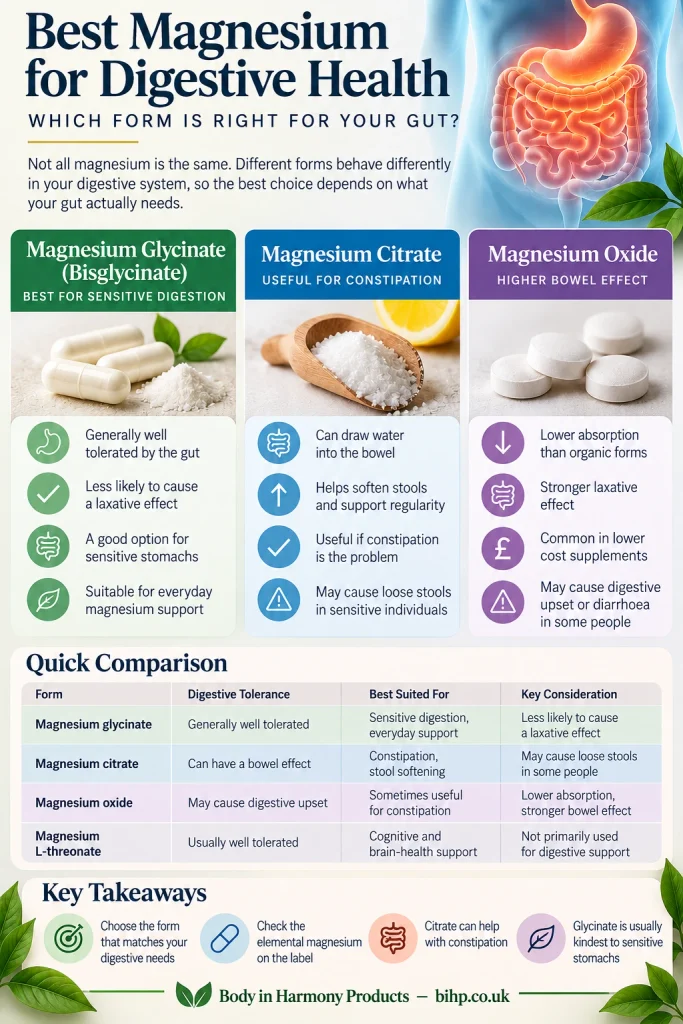
Best Magnesium for Digestive Health: Which Form Is Right for Your Gut?
The best magnesium for digestive health depends on what your digestive system actually needs.
If constipation is the problem, magnesium citrate may be useful because it can draw water into the bowel and soften stools.
If you already have a sensitive stomach, loose stools or simply want magnesium without much of a laxative effect, magnesium glycinate is usually the form I would look at first.
That distinction matters.
Magnesium oxide, citrate and glycinate all provide magnesium, but they behave differently once they reach your digestive system.
🌿 Best Magnesium for a Sensitive Stomach
For everyday magnesium supplementation where digestive tolerance matters, magnesium glycinate — also called magnesium bisglycinate — is one of the first forms I would consider.
In this form, magnesium is bound to the amino acid glycine.
That is different from magnesium oxide, where magnesium is attached to oxygen, or citrate, where it is bound to citric acid.
The practical difference is that glycinate is generally chosen when you want magnesium without deliberately trying to stimulate the bowel.
That makes it particularly interesting for people searching for:
- magnesium for a sensitive stomach
- magnesium that doesn’t cause diarrhoea
- magnesium glycinate for digestion
- an easily tolerated magnesium supplement
There is still variation between individuals, and any magnesium supplement can cause digestive symptoms if enough is taken.
But the form matters just as much as the number on the front of the bottle.
Magnesium supplements are only one part of the picture. I take the same approach with food: something can be nutritious on paper but still be a poor fit if it repeatedly leaves you bloated or uncomfortable.
My guide to holistic healing foods for everyday balance and digestion explains that approach in more detail.
🚽 Which Magnesium Is Best for Constipation?
This is where magnesium citrate becomes more useful.
Magnesium salts that remain within the intestine can increase the amount of water retained in the bowel.
That softens the stool and helps move intestinal contents along.
It is the same reason certain magnesium preparations have long been used as laxatives and even as part of bowel-cleansing preparations.
So if somebody is constipated, the bowel effect of magnesium citrate may be useful.
If somebody already suffers from loose stools, however, it may be exactly what they do not want.
Different problem. Different magnesium.
⚠️ What About Magnesium Oxide?
Magnesium oxide is one of the forms commonly found in inexpensive magnesium supplements.
There is a reason manufacturers like it.
A large proportion of the compound’s weight is magnesium, so it can produce an impressive-looking magnesium figure on a supplement label without requiring a large amount of raw material.
But the amount written on the bottle isn’t the whole story.
A review of different magnesium preparations reported considerably poorer fractional absorption for magnesium oxide than several organic magnesium salts. It also discussed differences in gastrointestinal tolerance between magnesium forms.
If you want to look at the evidence behind that comparison, this review of magnesium bioavailability and different magnesium preparations is the useful one.
That does not make magnesium oxide useless.
Its bowel action may actually be desirable in some circumstances.
But if I were choosing magnesium for someone primarily concerned about digestive tolerance, it would not usually be my first choice.
💚 Magnesium Glycinate vs Citrate for Digestion
The easiest way to think about the difference is:
| Form | When I would consider it |
|---|---|
| Magnesium glycinate | Sensitive digestion, everyday magnesium supplementation, avoiding an unnecessary laxative effect |
| Magnesium citrate | When constipation or stool softening is part of the reason for taking magnesium |
| Magnesium oxide | Cheap source of magnesium; stronger bowel effect can sometimes be useful but may be poorly tolerated |
| Magnesium L-threonate | Primarily interesting for cognitive and brain-health formulations rather than digestive support |
This is why asking “What is the best magnesium?” isn’t quite the right question.
The better question is:
“What am I taking magnesium for?”
🧠 Absorption Matters — But Don’t Get Carried Away With Marketing
You’ll often see supplement companies claiming their magnesium is dramatically more absorbable than everybody else’s.
The evidence is more nuanced.
Research generally suggests that some organic magnesium compounds are better absorbed than inorganic forms such as magnesium oxide, although direct human comparisons between every available form are limited.
If you want to compare another magnesium delivery method, I have also looked at liposomal magnesium and its absorption claims.
For me, the practical decision is simpler.
Choose the magnesium form that suits the reason you’re taking it and the way your digestive system responds to it.
💊 Don’t Be Fooled by the Big Number on the Bottle
The best magnesium for digestive health. This is one of the biggest things I would check when comparing magnesium supplements.
A label may say:
Magnesium Glycinate — 1,000 mg
That does not necessarily mean you are getting 1,000 mg of magnesium.
The important figure is the amount of elemental magnesium supplied.
That is the actual magnesium contribution from the compound.
So when comparing two products, look beyond the large number on the front and check:
How much elemental magnesium does the daily serving actually provide?
That makes product comparisons far more meaningful.
⚙️ Why Magnesium Matters Beyond Digestion
Magnesium isn’t simply a bowel mineral.
It is involved in hundreds of biochemical reactions and contributes to normal:
- muscle function
- nervous-system function
- energy-yielding metabolism
- psychological function
- electrolyte balance
- protein synthesis
It also contributes to reducing tiredness and fatigue.
These are established authorised functions of magnesium rather than invented supplement marketing claims.
The official authorised wording can be checked in the Great Britain nutrition and health claims framework.
That is another reason I prefer choosing the right form rather than buying magnesium purely because it is cheap.
✅ So What Is the Best Magnesium for Digestive Health?
There isn’t one magnesium that is best for every digestive problem.
My practical approach would be:
Sensitive stomach or prone to loose stools?
Look first at magnesium glycinate or bisglycinate.
Constipation?
Magnesium citrate may be more appropriate because its bowel effect can actually be useful.
Looking at a cheap magnesium oxide supplement?
Understand that the impressive elemental magnesium figure does not necessarily mean better absorption, and it may have a stronger laxative effect.
That is why I look at the form, elemental magnesium, dose and complete formulation before deciding whether a magnesium supplement is worth using.
🌿 Practitioner-Selected Magnesium Glycinate
There are hundreds of magnesium products available, and price alone tells you very little about their quality.
When I select one through my practitioner suppliers, I look for:
- magnesium glycinate or bisglycinate rather than relying mainly on magnesium oxide
- a clearly stated elemental magnesium dose
- sensible daily dosing
- transparent ingredients
- no unnecessary proprietary blend hiding the actual quantities
- a formulation that makes sense for the person taking it
[VIEW THE PRACTITIONER MAGNESIUM →]
Once we have selected the magnesium glycinate product from the practitioner catalogue, this section can link directly to it.