
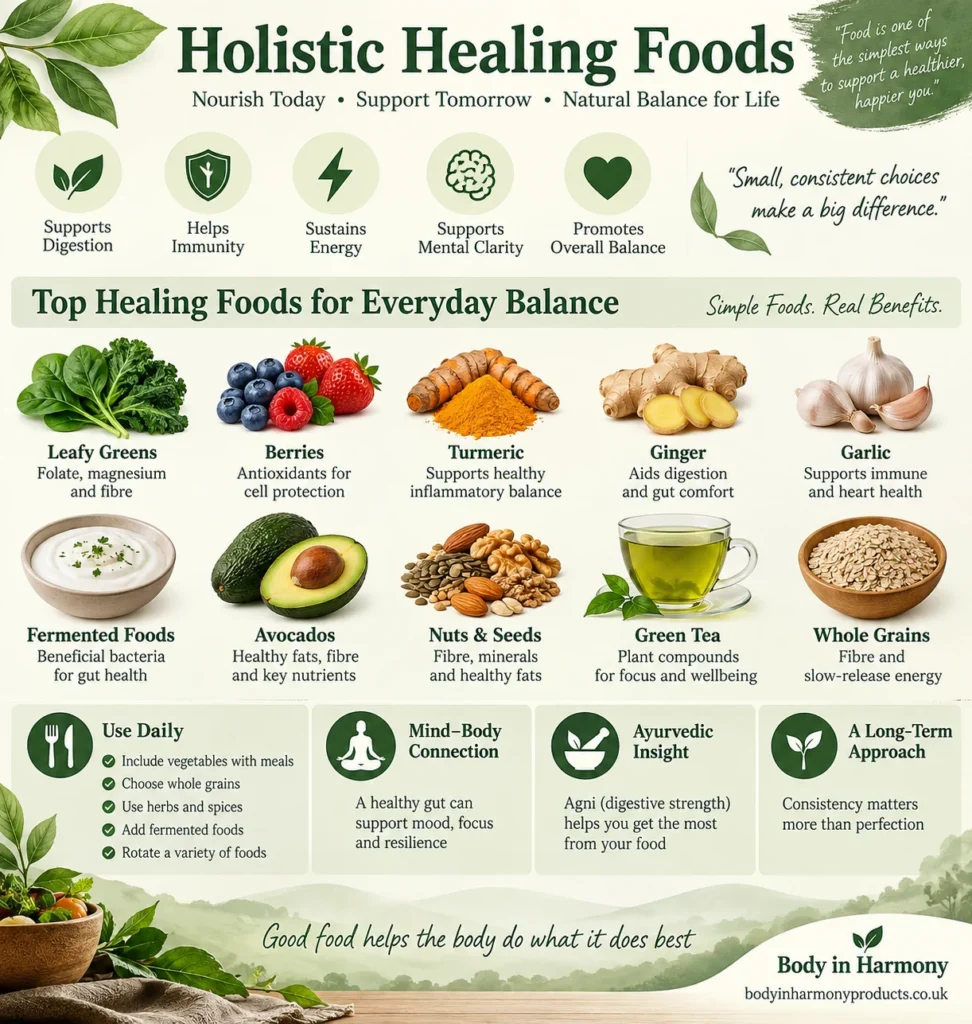
🌿 Holistic Healing Foods
Holistic healing foods focus on nourishing the whole body rather than chasing isolated symptoms.
The idea is simple. Food supplies protein, fats, fibre, vitamins, minerals and plant compounds that the body uses for energy production, tissue repair, digestion, nerve function and immune activity.
No single food creates perfect health. However, a varied whole-food diet gives the body the raw materials it needs to function properly.
🧠 What Makes Holistic Healing Foods Different?
Holistic nutrition looks at how food affects the body as a connected system.
Rather than focusing on calories alone, holistic healing foods provide nutrients that can influence several processes at the same time.
Fibre, for example, feeds certain gut bacteria. Magnesium is involved in nerve signalling and muscle function. Dietary fats help absorb the fat-soluble vitamins A, D, E and K.
That is where the holistic approach makes sense: one meal can affect digestion, energy, the nervous system and nutrient status together.
🌿 An Ayurvedic Herbalist View
From an Ayurvedic herbalist perspective, food is not judged only by calories or nutrient numbers.
Ayurveda also considers digestion, appetite, bowel habits, energy and individual constitution. Agni, or digestive capacity, sits at the centre of that traditional framework.
A food can be nutritious on paper but still be a poor choice if it repeatedly leaves someone bloated, heavy or uncomfortable.
Traditional spices such as ginger, cumin, coriander and turmeric are often used in Ayurveda to support digestion and make meals easier to process.
Modern research does not validate Ayurvedic theory as a whole, but it does support some of the actions traditionally associated with individual herbs. For example, this PMC review on ginger looks at human evidence for effects on nausea, gastrointestinal function and inflammatory pathways: https://pmc.ncbi.nlm.nih.gov/articles/PMC7019938/
That is the balance I want on BIHP: respect the traditional use, explain what Ayurveda says, then show where modern human evidence overlaps.
🥗 Holistic Healing Foods for Everyday Balance
You do not need unusual superfoods.
Some of the most useful foods are ordinary ingredients eaten regularly.
- 🥬 Leafy green vegetables
Spinach, kale and chard provide folate, magnesium, carotenoids and fibre. - 🫐 Berries
Blueberries, strawberries and raspberries contain anthocyanins and other polyphenols that help protect cells against oxidative stress. - 🌿 Turmeric
Turmeric contains curcuminoids, particularly curcumin. These compounds have been extensively studied for their influence on inflammatory signalling. - 🌱 Ginger
Ginger has a long history in both food and traditional medicine. Its gingerols and shogaols have been studied particularly for digestion, nausea and inflammatory pathways. - 🧄 Garlic
Crushing garlic produces sulphur-containing compounds including allicin. These compounds are one reason garlic has been studied in relation to cardiovascular and immune function. - 🥣 Fermented foods
Live yoghurt, kefir, sauerkraut and traditionally fermented vegetables can introduce microorganisms and fermentation products into the diet. Their effects vary considerably depending on the food and the person. - 🥑 Avocados
Avocados provide monounsaturated fats, fibre, potassium and several micronutrients. Dietary fat also helps with the absorption of fat-soluble nutrients. - 🌰 Nuts and seeds
Walnuts, flaxseed, chia and pumpkin seeds provide useful combinations of fibre, minerals and unsaturated fats. - 🍵 Green tea
Green tea contains catechins such as EGCG alongside a modest amount of caffeine, which may influence alertness and cellular antioxidant pathways. - 🌾 Whole grains
Oats, wholegrain barley, brown rice and other intact grains provide fibre and release carbohydrate more slowly than many highly refined alternatives.
Research supports this broader dietary pattern rather than the idea of individual “miracle foods”. A large systematic review and meta-analysis covering 45 prospective studies found that higher whole-grain intake was associated with lower cardiovascular and all-cause mortality risk. The research does not prove that grains heal disease, but it does support making fibre-rich whole foods a regular part of the diet.
⏰ How to Use Healing Foods Daily
You do not need strict rules.
A practical approach might be:
- include vegetables with two meals
- use herbs and spices regularly
- choose whole grains more often than refined versions
- include nuts, seeds or other healthy fats
- eat fermented foods if they suit your digestion
- rotate foods rather than relying on the same few ingredients
Consistency matters more than perfection.
🧘 Food and the Gut–Mind Connection
The digestive system and nervous system communicate continuously through what is known as the gut–brain axis.
Gut microbes produce metabolites, including short-chain fatty acids, while the nervous, immune and hormonal systems send signals in both directions.
That does not mean eating sauerkraut will instantly improve your mood.
Human research into fermented foods and the microbiome is interesting but still developing. Small intervention studies show that fermented foods can alter gut microbial populations, although effects on inflammatory markers and other health outcomes are not always consistent.
From an Ayurvedic perspective, this connection is not surprising.
Ayurveda has traditionally placed digestion, or Agni, near the centre of health. Poor digestion is viewed as something that can affect the wider system rather than remaining an isolated stomach problem.
The traditional explanation and the modern gut–brain model are not identical, but both recognise that digestion has effects beyond the gut.
🌱 A Long-Term Approach
Holistic healing foods work best as part of normal life rather than as a temporary diet.
Use whole foods as the foundation, eat a varied diet and choose ingredients that suit your digestion and individual needs.
That approach is also behind my guide to Food for Wellbeing, where I look more broadly at using everyday food to support balance without restrictive eating.