
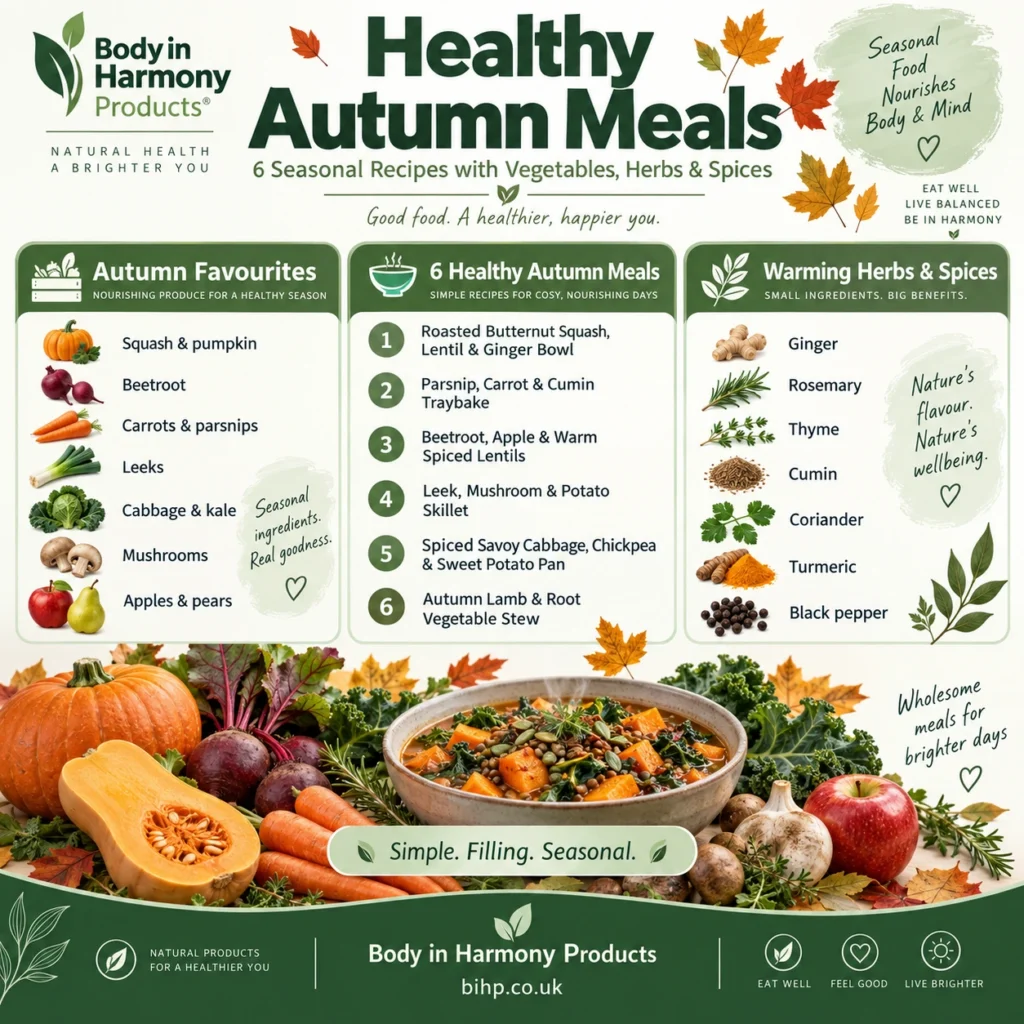
Autumn is one of the easiest times of year to build healthy autumn meals from ordinary whole foods. Squash, beetroot, carrots, cabbage, leeks, potatoes, mushrooms, apples and pears all work particularly well with warming herbs and spices.
As a nutritionist and Ayurveda herbalist, this is the kind of seasonal cooking I favour. Not because autumn food needs to follow complicated rules, but because cooked vegetables, decent protein, healthy fats and aromatic spices can produce filling meals without relying on heavily processed food.
🍂 Healthy Autumn Meals Start with Seasonal Food
September through November gives us some of the best British produce of the year.
The National Trust’s seasonal produce guide lists foods including beetroot, carrots, cabbage, cauliflower, potatoes, apples and pears during September, with leeks, kale, parsnips, swede, pumpkin and winter squash becoming particularly prominent through October and November.
Seasonal availability will vary slightly depending on where food is grown and when it is harvested, but these ingredients give us a solid foundation for autumn cooking.
🥕 Good autumn vegetables to use
- 🎃 Pumpkin and winter squash
- 🥕 Carrots
- 🌱 Parsnips
- Beetroot
- 🥬 Kale and cabbage
- 🧅 Leeks and onions
- 🥔 Potatoes and sweet potatoes
- 🍄 Mushrooms
- 🥦 Broccoli and cauliflower
- 🌿 Swede and turnip
Then bring them to life with herbs and spices rather than drowning them in sauces.
🌿 Herbs and spices that suit autumn cooking
- 🫚 Fresh ginger
- 🌿 Rosemary
- 🌿 Thyme
- 🌱 Parsley
- 🟤 Cumin
- 🌰 Coriander seed
- 🟡 Turmeric
- ⚫ Black pepper
- 🌱 Fennel seed
- 🤎 Cinnamon
🫚 Why Warming Spices Work So Well with Autumn Food
Spices aren’t only there to make vegetables taste better.
Ginger contains pungent compounds including gingerols and shogaols. These compounds have been investigated for several effects within the digestive system.
One small randomised crossover study involving people with functional dyspepsia found that 1.2 g of ginger accelerated gastric emptying compared with placebo. That doesn’t mean ginger fixes poor digestion, but it gives us a physiological reason why ginger has such a long association with digestive cooking.
If you want to examine that research, the study is available through PubMed Central.
From an Ayurvedic perspective, ginger and aromatic spices such as cumin and coriander have traditionally been used to support Agni, the digestive capacity. That traditional explanation isn’t the same thing as gastric-emptying research, but both help explain why warm, gently spiced food has remained such an important part of autumn and winter cooking.
🎃 1. Roasted Butternut Squash, Lentil and Ginger Bowl
This is a simple bowl with proper substance.
The squash provides carbohydrate and carotenoid pigments, while lentils add protein and fibre. Ginger, cumin and coriander give what could otherwise be a fairly sweet dish much more depth.
🛒 Ingredients
- 🎃 ½ medium butternut squash, cubed
- 🥣 100 g dried red lentils
- 🥬 2 handfuls spinach or chopped kale
- 🧅 ½ red onion
- 🫚 2 cm fresh ginger, finely grated
- 🟤 1 teaspoon ground cumin
- 🌰 1 teaspoon ground coriander
- 🟡 ½ teaspoon turmeric
- ⚫ Black pepper
- 🫒 1 tablespoon extra-virgin olive oil
- 🍋 Squeeze of lemon
- 🌿 Fresh coriander or parsley
🍳 Method
- 🔥 Heat the oven to 200°C.
- 🎃 Toss the squash and onion with olive oil, cumin, coriander, turmeric and black pepper.
- ⏱️ Roast for around 25–30 minutes until soft and browned at the edges.
- 🥣 Meanwhile, simmer the lentils until soft.
- 🫚 Stir the fresh ginger into the lentils towards the end of cooking.
- 🥬 Fold in the spinach or kale and allow it to soften.
- 🥄 Spoon into a bowl and top with the roasted squash and onion.
- 🍋 Finish with lemon and fresh herbs.
🌿 Why this combination works
Lentils turn roasted vegetables into a complete meal rather than a side dish.
The fat from the olive oil also helps with absorption of fat-soluble compounds such as carotenoids found in orange vegetables.
🥕 2. Parsnip, Carrot and Cumin Traybake with Herby Yoghurt
Root vegetables become sweeter when roasted because moisture is lost and browning reactions develop richer flavours.
Cumin balances that sweetness, while a sharp herb yoghurt keeps the meal from becoming heavy.
🛒 Ingredients
- 🥕 3 carrots
- 🌱 2 parsnips
- 🧅 1 red onion
- 🧄 2 garlic cloves
- 🟤 1 teaspoon cumin seeds
- 🌿 1 teaspoon dried thyme
- 🫒 1 tablespoon olive oil
- 🥣 150 g thick natural or Greek yoghurt
- 🌿 Small handful fresh parsley
- 🍋 Lemon juice
- ⚫ Black pepper
🍳 Method
- 🔥 Heat the oven to 200°C.
- 🔪 Cut the vegetables into similar-sized pieces.
- 🫒 Toss with olive oil, cumin, thyme, garlic and black pepper.
- ⏱️ Roast for approximately 30–35 minutes.
- 🥣 Mix the yoghurt with chopped parsley and lemon.
- 🥄 Spoon the yoghurt over the hot vegetables just before serving.
💡 Make it more substantial
Add:
- 🥚 Two boiled or poached eggs
- 🫘 Chickpeas
- 🍗 Leftover roast chicken
- 🥣 Cooked lentils
That changes a tray of vegetables into a much better balanced meal.
3. Beetroot, Apple and Warm Spiced Lentils
Beetroot and apple are a particularly good autumn pairing.
One brings earthy sweetness; the other brings acidity and freshness. Lentils provide the substance.
🛒 Ingredients
- 2 medium beetroot
- 🍎 1 crisp eating apple
- 🥣 150 g cooked green or Puy lentils
- 🌰 Small handful walnuts
- 🌿 Fresh parsley
- 🟤 ½ teaspoon cumin
- 🌰 ½ teaspoon coriander
- 🫚 1 teaspoon grated ginger
- 🫒 1 tablespoon olive oil
- 🍎 1 teaspoon apple cider vinegar
- ⚫ Black pepper
🍳 Method
- Roast the beetroot until tender, then cut into wedges.
- 🥣 Warm the lentils gently with cumin, coriander and ginger.
- 🍎 Thinly slice the apple.
- 🥄 Combine the warm lentils, beetroot and apple.
- 🌰 Scatter over walnuts and parsley.
- 🫒 Dress with olive oil, vinegar and black pepper.
🌰 Why add walnuts?
They provide fat, some plant protein and texture.
That matters because eating vegetables alone can leave a meal looking healthy while being surprisingly poor at keeping you satisfied.
🍄 4. Leek, Mushroom and Potato Skillet with Rosemary Eggs
Leeks, potatoes and mushrooms are inexpensive autumn ingredients, but there is no reason they have to end up in another bowl of soup.
Cooking them in a skillet creates browned edges and much more flavour.
🛒 Ingredients
- 🥔 300 g potatoes
- 🧅 1 large leek
- 🍄 200 g mushrooms
- 🧄 1 garlic clove
- 🌿 1 teaspoon chopped rosemary
- 🥚 2–4 eggs
- 🫒 1 tablespoon olive oil
- ⚫ Black pepper
🍳 Method
- 🥔 Parboil the potatoes until just tender and cut into chunks.
- 🫒 Heat the olive oil in a large frying pan.
- 🥔 Add the potatoes and allow the edges to brown.
- 🧅 Add sliced leek, mushrooms, rosemary and garlic.
- 🍄 Cook until the mushrooms have released their moisture and begun to brown.
- 🥚 Make small spaces in the vegetables and crack in the eggs.
- 🍳 Cover and cook gently until the whites are set but the yolks remain soft.
- ⚫ Finish with black pepper.
🍳 Why include the eggs?
They provide high-quality protein containing all nine essential amino acids.
For somebody who is physically active, rebuilding weight or simply wants an autumn meal that actually keeps them going, protein needs to be part of the picture.
If you want more practical meal ideas built around filling, nourishing food, see my Healthy Comfort Foods Made Simple: 5-Day Meal Plan for Strength and Energy.
🥬 5. Spiced Savoy Cabbage, Chickpea and Sweet Potato Pan
Cabbage deserves better than being boiled until it collapses.
Cooked quickly with chickpeas, sweet potato and spices, it becomes the main part of the meal.
🛒 Ingredients
- 🥬 ½ Savoy cabbage
- 🍠 1 medium sweet potato
- 🫘 1 tin chickpeas, drained
- 🧅 1 onion
- 🫚 2 cm fresh ginger
- 🟤 1 teaspoon cumin
- 🟡 ½ teaspoon turmeric
- 🌰 ½ teaspoon ground coriander
- ⚫ Black pepper
- 🫒 1 tablespoon olive oil
- 🌿 Fresh coriander or parsley
🍳 Method
- 🍠 Cube and steam or roast the sweet potato until almost tender.
- 🧅 Gently fry the onion in olive oil.
- 🫚 Add ginger, cumin, turmeric and coriander.
- 🫘 Add the chickpeas and cooked sweet potato.
- 🥬 Finely slice the cabbage and add it to the pan.
- 🔥 Cook just until tender rather than boiling it to death.
- 🌿 Finish with fresh herbs.
🥬 There is some interesting chemistry in cabbage
Cabbage belongs to the Brassica family alongside broccoli, cauliflower and kale.
These vegetables naturally contain glucosinolates. When the plant tissue is chopped or chewed, the enzyme myrosinase helps convert glucosinolates into biologically active compounds including isothiocyanates.
A review of the human and preclinical evidence discusses how these compounds interact with antioxidant and cellular defence pathways, although researchers also make clear that the clinical evidence is still developing.
The full review is available on PubMed Central.
That’s a better reason to eat cabbage than calling it a fashionable “superfood”. It’s simply a useful, inexpensive vegetable with some interesting plant chemistry behind it.
🍲 6. Autumn Lamb and Root Vegetable Stew
Healthy autumn recipes don’t have to be vegetarian.
Lamb works extremely well with root vegetables, mushrooms and woody herbs. A slow-cooked stew is also a practical way of turning cheaper cuts of meat into something tender.
🛒 Ingredients
- 🥩 500 g diced lamb
- 🥕 2 carrots
- 🌱 2 parsnips
- 🌿 ¼ swede
- 🧅 1 leek
- 🍄 150 g mushrooms
- 🧄 2 garlic cloves
- 🌿 1 sprig rosemary
- 🌿 2 sprigs thyme
- 🍲 600 ml stock
- 🫒 1 tablespoon olive oil
- ⚫ Black pepper
🍳 Method
- 🥩 Brown the lamb in a heavy casserole pan.
- 🧅 Add the leek and garlic and cook for several minutes.
- 🥕 Add the carrots, parsnips, swede and mushrooms.
- 🌿 Add rosemary, thyme and black pepper.
- 🍲 Pour over enough stock to almost cover everything.
- 🔥 Bring to a gentle simmer.
- ⏱️ Cover and cook slowly for around 1½–2 hours, or until the lamb is tender.
- 🌿 Remove the herb stalks before serving.
🥩 Why this makes sense nutritionally
Lamb supplies complete protein, iron, zinc and vitamin B12.
Combining it with several different vegetables gives you a much broader meal than the traditional plate of meat with one token vegetable sitting beside it.
🌿 An Ayurvedic View of Autumn Cooking
Ayurveda traditionally regards autumn as a period when the environment becomes progressively cooler, drier and more changeable.
The usual dietary response is not complicated.
- 🍲 Favour more cooked meals.
- 🥕 Use naturally sweet root vegetables.
- 🫒 Include adequate fats rather than eating everything dry.
- 🫚 Use ginger and aromatic spices appropriately.
- 🥣 Choose soups and stews when appetite or digestion feels unsettled.
- ❄️ Reduce excessive amounts of fridge-cold food if it leaves you feeling heavy or uncomfortable.
- 🍽️ Eat according to appetite rather than automatically grazing all day.
Ayurveda describes this through Agni and the seasonal qualities affecting Vata.
Modern nutrition uses different terminology, so the two shouldn’t be presented as if they are the same system. But the practical idea of shifting towards warm, cooked, nourishing food as British weather becomes colder is hardly unreasonable.
If Ayurveda is new to you, my Beginner’s Guide to Ayurveda explains Agni, the doshas and the basic principles without making them unnecessarily complicated.
🍁 Building Your Own Healthy Autumn Meals
You don’t need a recipe every time you cook.
A useful autumn plate can be built from four basic parts:
- 🥕 Seasonal vegetables: squash, carrots, beetroot, cabbage, leeks or mushrooms.
- 🥚 Protein: eggs, lentils, beans, fish, chicken, lamb or good-quality yoghurt.
- 🫒 Fat: olive oil, nuts, seeds, yoghurt or another suitable whole-food source.
- 🌿 Herbs and spices: ginger, cumin, coriander, rosemary, thyme, turmeric or black pepper.
Change those four components and you can produce dozens of different meals without buying a cupboard full of specialist ingredients.
🍂 Simple Food Suits Autumn
The best healthy autumn meals don’t need a long list of fashionable ingredients.
Start with vegetables that are actually in season. Add enough protein and healthy fat to make the meal substantial. Then use herbs and spices properly so the food tastes good enough that you want to cook it again.
That’s seasonal eating in practical terms.
Good ingredients. Proper food. And meals that suit the time of year.