
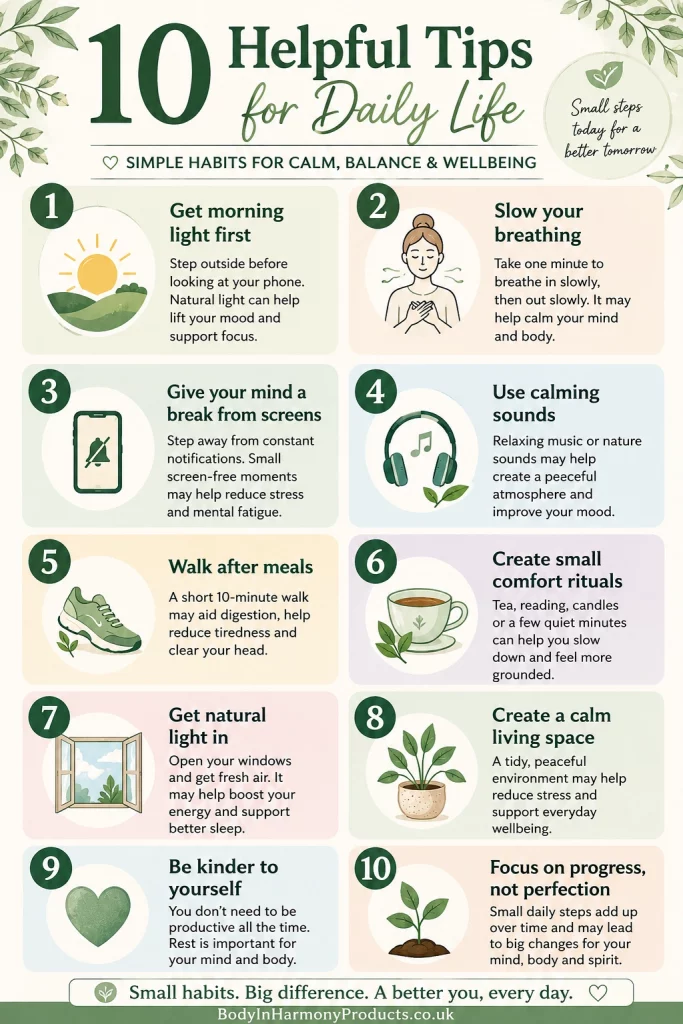
🌞 10 Helpful Tips for Daily Life to Calm a Busy Mind
When your mind is constantly racing, even simple jobs can start feeling harder than they should.
As an Ayurvedic herbalist and nutritionist, I look at this from the whole-body angle. Stress is not only about what is happening in your head. Sleep, food, breathing, movement, stimulation and your daily routine all play a part.
These helpful tips for daily life are simple enough to use without turning wellbeing into another job.
🫁 1. Slow Your Breathing
Stress often changes the way we breathe without us noticing.
Breathing becomes quicker and shallower, which can keep the body feeling switched on.
Try slowing the breath down for five minutes:
- Breathe gently through your nose
- Let the abdomen expand naturally
- Slow the exhale
- Keep the breathing comfortable rather than forcing it
A systematic review covering 58 clinical studies found that regulated breathing practices reduced measures of stress or anxiety in many of the interventions studied. Slow breathing was one of the most commonly used approaches.
Research on Breathing, Stress and Anxiety
Ayurveda and yoga have also used controlled breathing, including Pranayama, for centuries as part of practices aimed at calming and balancing the mind.
🌿 2. Get Outside
Sometimes the mind needs less stimulation rather than another technique.
Go for a walk, sit in the garden or spend ten minutes somewhere green without staring at your phone.
Research has linked exposure to natural environments with better mental wellbeing, cognitive function and lower psychological stress, although the size of the benefit varies between studies.
You do not need a forest retreat.
A local park will do.
📵 3. Give Your Brain Some Screen-Free Time
Moving from laptop to phone to television gives the brain very little quiet time.
Create a few gaps.
Leave the phone away from the dinner table. Switch unnecessary notifications off. Give yourself half an hour without a screen in the evening.
You do not have to disappear into a digital detox camp.
Just stop feeding your attention every spare second.
🌞 4. Get Some Morning Daylight
Natural light helps regulate the body’s circadian rhythm, which influences sleep, alertness and mood.
Open the curtains properly and get outside when you can.
A short morning walk gives you daylight and movement at the same time.
That is a better start to the day than rolling over and immediately reading twenty notifications.
🚶 5. Move During the Day
Movement does not need to mean hammering yourself in the gym.
Walk after lunch. Stretch. Do some gardening. Take the stairs.
After decades of physical work, I know how different both the body and mind feel when movement is part of everyday life rather than something squeezed into one hour at the gym.
Ayurveda also places value on regular movement, but the amount should suit the individual rather than becoming another form of exhaustion.
🍵 6. Use Herbs as Part of the Routine
This is where the herbalist side comes in.
A warm herbal tea can create a useful break in the day while also giving you something other than another coffee.
Depending on the person, gentle herbs might include:
- Chamomile
- Lemon balm
- Tulsi
- Fennel
- Peppermint
I would not treat every herb as suitable for everybody.
Ayurveda looks at constitution, digestion and current imbalance rather than assuming one “calming herb” works the same way for everyone.
Sometimes the ritual matters too.
Making the tea, sitting down and drinking it without doing three other jobs at the same time is part of slowing things down.
🍽️ 7. Don’t Ignore Food and Hydration
A busy mind can become worse when the rest of the body is running on fumes.
Skipping meals, living on coffee and then eating rubbish at nine o’clock at night is not a great foundation for feeling balanced.
As a nutritionist, I would keep the basics straightforward:
- Eat proper meals
- Include protein
- Eat plenty of vegetables and fruit
- Include healthy fats
- Drink enough water
- Do not rely on caffeine for energy
Ayurveda would also look at Agni, or digestive strength.
Regular meals that digest comfortably can be more useful than continually grazing while stressed and distracted.
🪴 8. Make Your Surroundings Less Chaotic
Your environment does affect how settled you feel.
You do not need a minimalist house with one chair and a bonsai tree.
Start with the obvious stuff.
Clear the work surface. Open a window. Put things away. Create one area where you can sit without staring at clutter.
If everything around you feels frantic, creating a bit of physical space can help create some mental space too.
🧠 9. Stop Treating Rest Like Laziness
Constant productivity is not a badge of honour.
The body needs periods of activity and periods of recovery.
Ayurveda has always recognised the importance of daily rhythms, sleep and balancing exertion with restoration.
Rest does not necessarily mean lying on the sofa for six hours.
Reading, walking quietly, gardening, listening to music or simply sitting without doing anything productive for ten minutes all count.
💚 10. Pick Two Things and Actually Do Them
This is probably the most useful tip on the page.
Do not read ten helpful tips for daily life and decide that tomorrow you are becoming a completely different person.
Pick two.
Maybe you walk for ten minutes after lunch and leave your phone downstairs in the evening.
Once those become normal, add something else.
From both an Ayurvedic and nutritional point of view, steady routines usually beat extreme changes that last four days.
You are trying to make everyday life feel more balanced, not create another list of things you are failing to do.
For a wider look at building healthier routines around the mind and body, read our Essentials for Healthy Living: Mind, Body and Spirit from Body in Harmony Products.