
🥄 Organic Baking Soda: Surprising Health & Skin Benefits
Organic baking soda, better known as sodium bicarbonate, is more than just a kitchen staple.
It has established uses for indigestion, specific medical uses involving acid-base balance, and surprisingly strong evidence in sports performance.
As a qualified Diet and Nutritional Advisor, I think the useful part is separating what sodium bicarbonate genuinely does from the exaggerated claims often attached to it.
🧪 What Is Organic Baking Soda?
Baking soda is sodium bicarbonate, written chemically as NaHCO₃.
It forms a mildly alkaline solution when dissolved in water.
The word “organic” is often used commercially, but sodium bicarbonate itself is an inorganic mineral compound. For health use, purity and food-grade quality matter more than the label.
🔥 Baking Soda for Indigestion and Heartburn
One of its best-established uses is as an antacid.
Sodium bicarbonate reacts with hydrochloric acid in the stomach and temporarily reduces acidity.
This can provide short-term relief from heartburn and indigestion.
The NHS guidance on antacids confirms that sodium bicarbonate is used in some antacid medicines for short-term symptom relief.
That does not mean the whole body needs “alkalising”. Blood pH is tightly controlled by the lungs and kidneys.
If you want to understand the difference between acidic foods and the body’s actual pH regulation, our guide to The Truth About Acidic Foods explains it in more detail.
🏃 Sodium Bicarbonate and Sports Performance
This is where the research becomes particularly interesting.
During intense exercise, hydrogen ions accumulate around working muscle and contribute to the increasing acidity associated with fatigue.
Sodium bicarbonate increases bicarbonate in the blood, improving the body’s ability to buffer those hydrogen ions.
A major review published on PubMed Central found that sodium bicarbonate can improve performance during certain types of high-intensity exercise, particularly where acid accumulation becomes limiting.
The evidence includes activities such as sprinting, cycling, rowing, swimming, combat sports and muscular endurance.
If you want to look at the research behind this, this PubMed Central review on sodium bicarbonate and exercise performance examines decades of research and explains how the buffering effect works.
The benefit is real, although the doses used in sports research can also cause bloating, nausea and diarrhoea.
🩺 Baking Soda and Kidney Disease
There is also genuine medical research involving the kidneys.
Healthy kidneys help maintain acid-base balance by removing hydrogen ions and conserving bicarbonate.
In chronic kidney disease, this ability can decline. Some people develop metabolic acidosis, where blood bicarbonate becomes too low.
In selected patients, sodium bicarbonate may be prescribed to correct that imbalance.
Some research suggests that correcting metabolic acidosis may also help slow kidney deterioration in certain people with chronic kidney disease.
That is very different from saying that drinking baking soda makes healthy kidneys work better.
🦷 Supporting Oral Health
Baking soda is commonly included in toothpaste because of its mild abrasive action.
It can help remove surface staining and plaque and can also help neutralise acids in the mouth.
For regular use, I would favour a properly formulated bicarbonate toothpaste rather than repeatedly scrubbing the teeth with plain powder.
🛁 Baking Soda and Skin
Baking soda is sometimes added to bath water to soothe minor itching and irritation.
However, healthy skin naturally maintains a slightly acidic surface known as the acid mantle. This helps support the skin barrier and normal microorganisms living on the skin.
Frequent use of concentrated baking soda can disturb that balance and cause dryness or irritation.
So while an occasional diluted bath may feel soothing, I would not describe baking soda as a treatment for acne or eczema.
⚠️ Should You Drink Baking Soda Every Day?
I would not treat baking soda as an everyday supplement.
It contains a significant amount of sodium, and larger amounts can cause:
- nausea
- bloating
- abdominal discomfort
- diarrhoea
- disturbances in fluid and electrolyte balance
The amount used medically, as an antacid, or in sports research varies considerably.
That is why blanket advice such as taking half a teaspoon once or twice every day is too simplistic.
✅ The Bottom Line
Organic baking soda has some genuinely interesting health applications.
Its strongest evidence lies in its ability to neutralise stomach acid, buffer acidity during intense exercise and correct metabolic acidosis in specific medical circumstances.
It also has practical uses in oral care and occasional skin care.
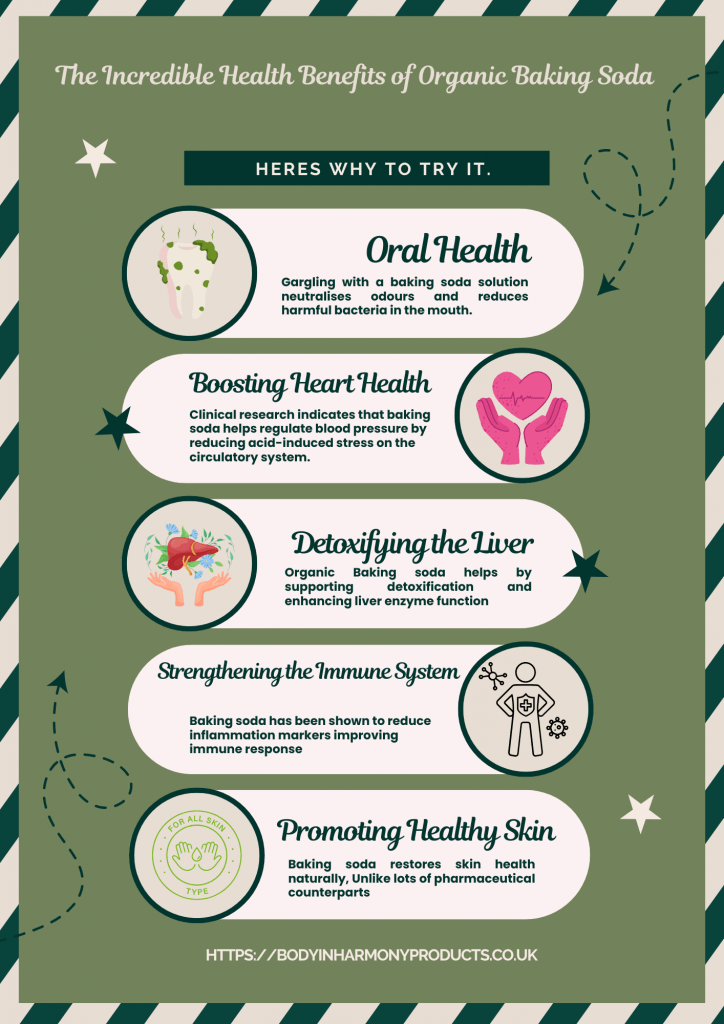
What it does not need are exaggerated claims about detoxifying the liver, boosting immunity or alkalising the entire body.
The real science behind sodium bicarbonate is interesting enough without adding anything to it.