
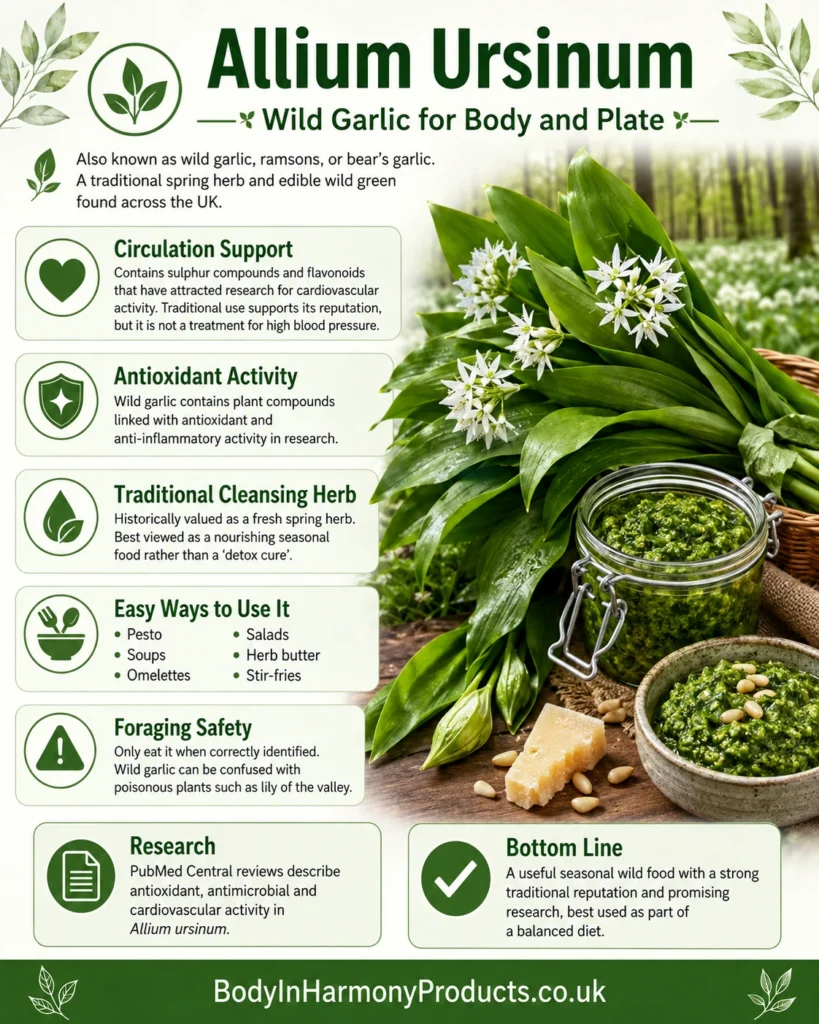
🌿 Allium Ursinum: Nature’s Wild Remedy for Body and Plate
Allium ursinum, better known as wild garlic, ramsons or bear’s garlic, is one of the most useful wild foods found across the UK each spring.
It has a long history in European herbalism and contains sulphur compounds, flavonoids and other phytochemicals that have attracted modern research.
As a practitioner of Ayurvedic Herbalism and a qualified Diet and Nutritional Advisor, I think wild garlic is best viewed as both a nutritious seasonal food and a traditional herb with some genuinely interesting biological activity.
🌱 What Is Allium Ursinum?
Allium ursinum is a wild relative of cultivated garlic.
It grows in damp woodland and produces broad green leaves followed by distinctive white star-shaped flowers.
The leaves, flowers and bulbs are edible, although the leaves are the part most commonly gathered for food.
A scientific review of wild garlic describes a long traditional history of use and identifies sulphur compounds, flavonoids and other plant chemicals with antioxidant, antimicrobial and cardiovascular activity.
Read the Allium ursinum research on PubMed Central
❤️ Wild Garlic and Circulation
One of the best-known traditional uses of wild garlic is cardiovascular support.
Its sulphur compounds include relatives of those found in ordinary garlic, including allicin-related compounds.
Laboratory and animal research on Allium ursinum has found effects involving platelet aggregation, blood vessels and cardiovascular function.
That makes the traditional use interesting, but it does not mean eating wild garlic will reliably lower high blood pressure.
The human evidence specifically for A. ursinum remains limited.
🧪 Antioxidant and Anti-Inflammatory Activity
Wild garlic contains flavonoids and sulphur-containing phytochemicals that show antioxidant and anti-inflammatory activity in experimental research.
These compounds may help protect cells from oxidative stress and influence inflammatory signalling.
More recent reviews of Allium plants continue to identify A. ursinum as a source of potentially useful antioxidant and anti-inflammatory compounds.
That supports its reputation as a biologically active plant without turning it into a treatment for inflammatory disease.
🥬 What About “Detox”?
Wild garlic has traditionally been described as a cleansing spring herb.
That language makes sense historically, especially when fresh greens returned after a winter diet.
Modern physiology is more specific.
The liver and kidneys handle detoxification continuously. Wild garlic does not need to “flush toxins” to be useful.
Its real value comes from the nutrients and sulphur compounds it contributes as part of a varied diet.
🦠 Traditional Antimicrobial Use
Another interesting area is antimicrobial activity.
Extracts of wild garlic have shown activity against certain microorganisms in laboratory studies.
That helps explain why Allium plants developed such a strong reputation in traditional herbalism.
However, eating wild garlic should not be described as treating an infection.
Laboratory activity and clinical treatment are not the same thing.
🍃 How to Use Wild Garlic
Fresh leaves have a milder flavour than ordinary garlic and work well in:
- pesto
- soups
- omelettes
- salads
- sauces
- stir-fries
- herb butter
You can also chop it through cooked vegetables or add it near the end of cooking to preserve more of its fresh flavour.
⚠️ Foraging Safety Matters
This is the most important practical warning.
Wild garlic can grow alongside poisonous plants, including lily of the valley, which is toxic if eaten. The RHS confirms that wild garlic is a common UK native and that lily of the valley is poisonous.
The garlic smell is useful for identification, but I would never rely on smell alone.
Only eat a wild plant when you are completely certain of the identification.
🐻 Why Is It Called Bear’s Garlic?
The name ursinum comes from the Latin word ursus, meaning bear.
Old European folklore claimed that bears ate wild garlic after hibernation to regain strength and “cleanse” themselves.
That is a traditional story rather than a proven physiological effect, but it shows how deeply the plant is rooted in European herbal culture.
✅ The Bottom Line
Allium ursinum deserves its reputation as more than just a woodland edible.
It contains sulphur compounds and flavonoids with promising antioxidant, antimicrobial and cardiovascular activity, while also having a long history of traditional herbal use.
What we should avoid is stretching that into claims that wild garlic detoxifies the liver, treats hypertension or cures infection.
For a broader look at using natural foods and herbs as part of everyday health, see our guide to Physical Wellbeing: Supporting Balance in Everyday Life.