
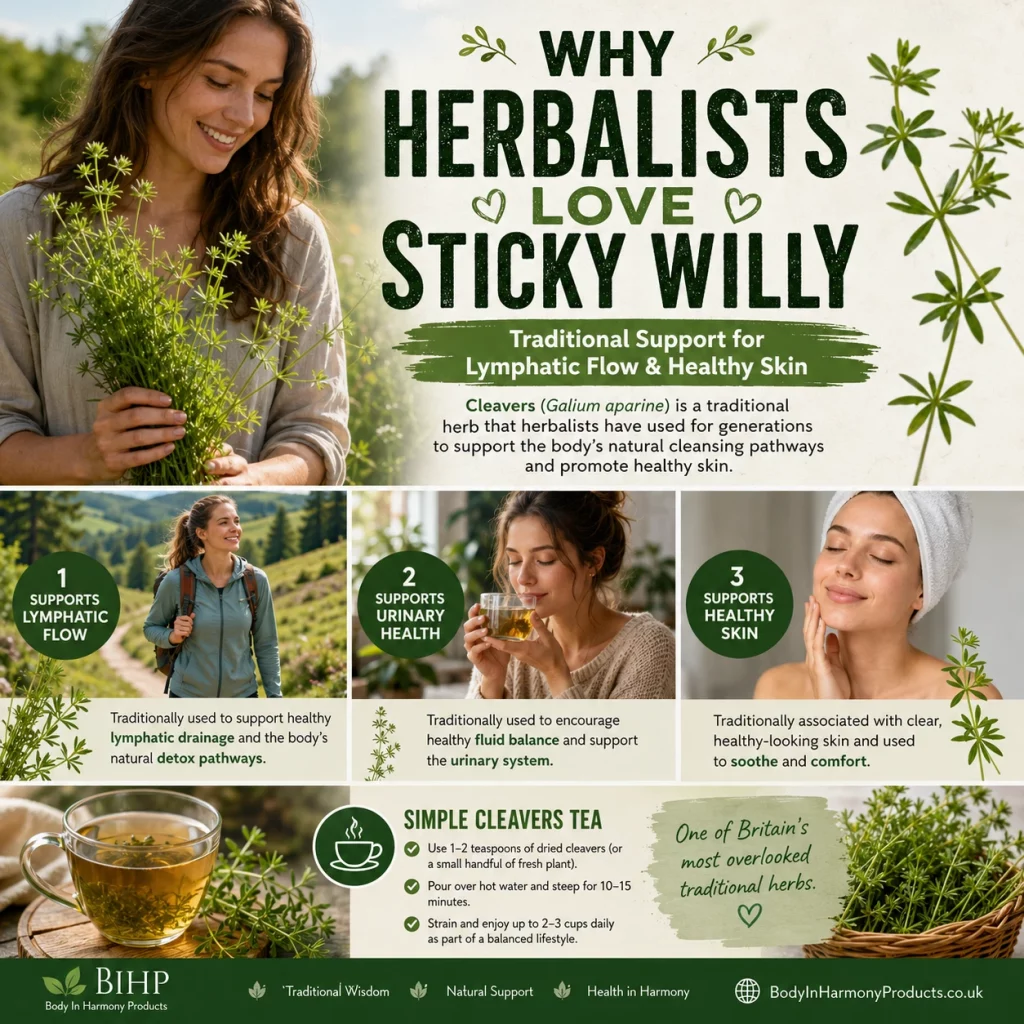
🌿 Sticky Willy Plant Benefits: Cleavers for Lymphatic, Urinary and Skin Support
The sticky willy plant benefits are far more interesting than most people realise when they are pulling this clingy plant off their clothes.
Better known to herbalists as cleavers (Galium aparine), sticky willy has a long history of use in traditional herbal medicine, particularly around the lymphatic system, urinary function and skin.
It grows abundantly throughout Britain, which makes it one of those useful herbs hiding in plain sight.
🌱 Sticky Willy Plant Benefits for the Lymphatic System
Cleavers is one of the traditional herbs I associate most strongly with lymphatic movement and stagnation.
The lymphatic system helps move fluid around the body and plays an important part in immune function.
In Western herbalism, cleavers has long been used where lymph feels sluggish or congested, particularly around swollen glands and fluid retention.
From an Ayurvedic herbalist’s point of view, I would look at cleavers as a cooling, cleansing and moving herb.
That makes it particularly interesting where there are signs of stagnation, heat or sluggish fluid movement rather than simply treating it as another generic “detox herb”.
Modern ethnobotanical research records the same traditional reputation, including its use to promote lymphatic circulation.
💧 Cleavers and Urinary Function
Cleavers also has a longstanding reputation as a mild diuretic herb.
That simply means it has traditionally been used to encourage normal urine production and help the body move excess fluid.
This connection between the lymphatic and urinary systems makes sense from a traditional herbal perspective.
If the body is struggling with stagnant fluid, herbalists often look at several routes of elimination rather than treating one organ in isolation.
Cleavers has therefore appeared for generations in spring tonics, cleansing teas and herbal preparations aimed at supporting normal fluid balance.
Research into Galium aparine also records its traditional use as a diuretic and in preparations for urinary complaints.
🛡️ Sticky Willy Plant Benefits for the Skin
The skin is another area where cleavers has earned a strong traditional reputation.
Herbalists have used it internally and externally for irritated skin, wounds and other skin complaints.
From a holistic perspective, this fits nicely with its traditional lymphatic role.
Skin problems are not always just about what is happening on the surface. Herbal traditions have long looked at circulation, elimination, digestion and fluid movement as part of the wider picture.
Modern laboratory research has found antioxidant and immunomodulatory activity in cleavers extracts, while other studies have explored its traditional use for skin and wound support.
Research into Cleavers and Traditional Skin Use
That does not mean every traditional claim has been clinically proven.
It does show that some of the old herbal uses are interesting enough to deserve proper investigation rather than being dismissed as folklore.
🍵 How Cleavers Is Traditionally Used
Cleavers is most commonly prepared as an infusion.
Dried cleavers can be steeped in hot water and strained before drinking.
Fresh young cleavers have also traditionally been used when the plant is in season.
Because the stems and leaves are covered in tiny hooked hairs, fresh cleavers is generally better infused, cooked or prepared rather than chewed raw like salad leaves.
As with any wild herb, identification matters.
Only gather plants you can confidently identify, and avoid roadsides or areas that may have been sprayed with chemicals.
🌿 Why Herbalists Still Value Cleavers
For me, cleavers is a good example of why traditional herbal knowledge should not be thrown aside simply because modern research has not yet caught up with every use.
Herbalists have valued it for generations for:
- 🌱 Lymphatic movement
- 💧 Urinary and fluid balance
- 🛡️ Skin support
- 🍵 Traditional spring cleansing preparations
Modern analysis has identified compounds including iridoids, flavonoids and phenolic acids within the plant, while laboratory studies have found antioxidant and immune-related activity.
That research is useful because it helps us understand the plant more deeply.
But the traditional use came first.
As an Ayurvedic herbalist and nutritionist, I prefer to look at both sides: the long history of practical herbal use and the modern work exploring why those traditions may have developed in the first place.
For more guides on traditional herbs and everyday wellbeing, read our Herbs and Spices for Wellbeing Natural Remedies from Body in Harmony Products.