
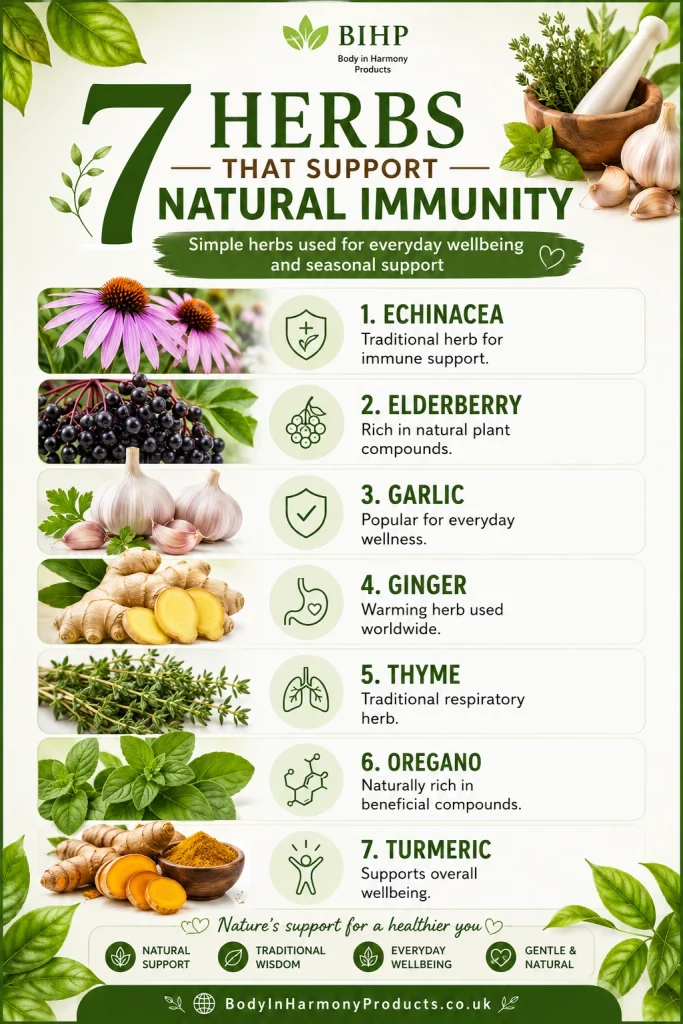
🌿 Herbs That Support Natural Immunity for Everyday Wellbeing
As an Ayurvedic herbalist and nutritionist, I look at immunity from both sides.
Herbs can provide useful plant compounds and traditional support, but they work best alongside good food, sleep, movement and a body that is properly nourished.
That is where herbs that support natural immunity make the most sense — as part of the bigger picture rather than as a magic shield against illness.
🧄 Garlic
Garlic has been used as both food and medicine for centuries.
From a nutritional point of view, garlic contains sulphur compounds such as allicin, which have attracted plenty of research interest for their antimicrobial and immune-related effects.
From an Ayurvedic perspective, garlic is strongly heating and stimulating. It can help move sluggishness and support digestion, but it is not something I would pile into somebody who already runs very hot or has irritated digestion.
Use it regularly in soups, stews, sauces and roasted vegetables rather than treating it like a supplement you have to force down.
🫚 Ginger
Ginger is one of the most useful everyday herbs for digestion and seasonal wellbeing.
Ayurveda values ginger for supporting Agni, warming the digestive system and helping move cold, heavy or sluggish qualities.
Modern research has identified gingerols and shogaols as some of its key bioactive compounds, with interest around their antioxidant, anti-inflammatory and immune-related activity.
Fresh ginger works well in tea, curries, soups and stir-fries.
As always, more is not automatically better. Someone with a lot of Pitta-type heat or burning reflux may need a gentler approach.
🟡 Turmeric
Turmeric has a long history in Ayurveda and Indian cooking.
Its best-known compound is curcumin, although the whole spice contains a range of naturally occurring plant compounds.
From an Ayurvedic herbalist’s point of view, turmeric is traditionally used where there is stagnation and imbalance, and it has been valued as part of wider digestive and wellbeing routines.
Modern research has also explored curcumin in relation to inflammatory signalling and immune function.
You do not need enormous supplement doses to use turmeric sensibly.
Adding it to curries, soups, lentils and rice gives you the herb as part of real food, which is where I prefer to start.
🌿 Thyme and Oregano
Thyme and oregano tend to get overlooked because they are sitting in nearly everybody’s kitchen cupboard.
Both belong to the Lamiaceae family and contain aromatic plant compounds that have been studied for antimicrobial and antioxidant activity.
Herbalists have also traditionally used thyme around the respiratory system, particularly in teas and preparations used during colder months.
Oregano works easily in tomato sauces, soups and roasted vegetables, while thyme is ideal with beans, chicken, casseroles and root vegetables.
Using herbs regularly in food is one of the simplest ways to increase the variety of plant compounds in your diet.
🫐 Elderberry
Elderberry has a long traditional reputation for seasonal and respiratory support.
The dark berries contain anthocyanins, the same family of pigments found in many deep red, blue and purple fruits.
A systematic review of human trials found that elderberry may reduce the duration or severity of some viral respiratory symptoms, although the researchers were clear that the evidence remains uncertain.
That is a useful finding without turning elderberry into something it isn’t.
Traditional herbal use gives us one side of the picture, while modern research helps us understand where those old practices may have some biological basis.
Elderberry and Respiratory Health Research
🌸 Echinacea
Echinacea is another classic seasonal herb.
Traditional Western herbalism has used the root and aerial parts of different Echinacea species to support the body’s response during colds and respiratory infections.
Human research suggests echinacea may help reduce the duration or severity of some acute respiratory infections when used around the start of symptoms, although results vary between preparations and studies.
That variation matters because one echinacea product is not automatically identical to another.
🍽️ Nutrition Still Sits Underneath Everything
This is where the nutritionist side of the picture matters.
The immune system needs enough energy, protein, vitamins, minerals and healthy fats to function normally.
No herb can compensate for a diet that is consistently short of essential nutrients.
That means keeping the foundations simple:
- Eat a good variety of vegetables and fruit
- Include enough protein
- Use herbs and spices regularly
- Include healthy fats
- Get enough sleep
- Keep moving
- Give digestion time to do its job
Research looking at herbs, spices and immune health also supports the idea that they are most useful as part of a varied, nutrient-rich diet, rather than being treated as isolated miracle ingredients.
Research on Herbs, Spices and Immune Support
🌿 A Herbalist’s Approach to Natural Immunity
The herbs I would look at depend on the person.
Someone who feels cold, sluggish and heavy may respond very differently to ginger and garlic than somebody who already runs hot, dry or irritated.
That is one of the strengths of Ayurveda.
We are not simply asking, “Which herb boosts immunity?”
We are looking at digestion, constitution, food, sleep, stress, seasonal changes and the overall state of the person.
Herbs that support natural immunity work best when they are chosen with that wider picture in mind.
For more guides on everyday herbal use, read Herbs and Spices for Natural Health and Everyday Wellbeing from Body in Harmony Products.