
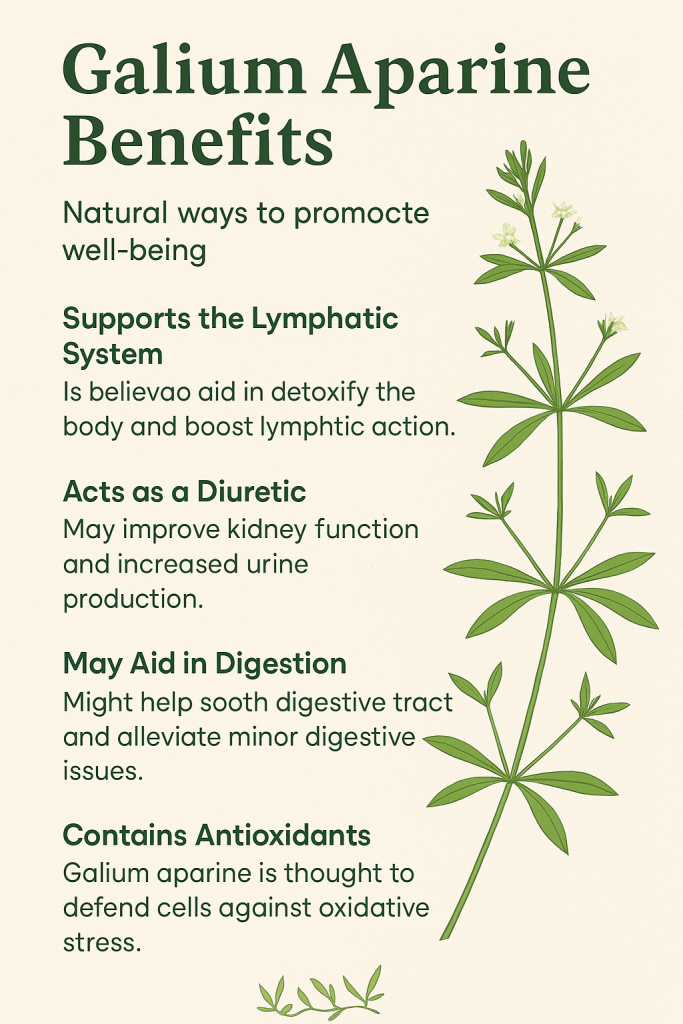
🌿 Galium Aparine Benefits: The Wild Herb Better Known as Cleavers
Galium aparine benefits have been recognised in traditional herbalism for generations, particularly in relation to the lymphatic system, skin and urinary tract.
Better known as cleavers, goosegrass or sticky willy, this wild herb grows widely across the UK and Europe and is often overlooked despite its long history of use.
As a practitioner of Ayurvedic Herbalism and a qualified Diet and Nutritional Advisor, I think cleavers is a good example of where traditional herbal knowledge and modern research can sit alongside each other without exaggerating what the plant can do.
🌱 What Is Galium Aparine?
Cleavers grows widely across the UK and Europe.
You will recognise it by its sticky stems and leaves, which cling to clothing and animal fur.
Traditionally, herbalists have used the aerial parts of the plant as a gentle diuretic, lymphatic herb and topical remedy for skin complaints.
That does not mean every traditional claim has been clinically proven, but there is some interesting research behind the plant.
💧 Traditional Support for the Lymphatic System
One of the best-known traditional Galium aparine benefits is its use as a lymphatic herb.
The lymphatic system helps move fluid through tissues and plays an important role in immune function.
Traditional herbalists use cleavers where there is puffiness, swollen glands or a sense of sluggish fluid movement.
Modern research has not yet confirmed that cleavers directly “cleans” or detoxifies the lymphatic system in humans, so I would keep this firmly within its traditional herbal use rather than present it as proven physiology.
🚰 Mild Diuretic Use
Cleavers has also traditionally been used as a mild diuretic.
A diuretic increases urine production, which explains why the herb has historically been associated with urinary and fluid-balance remedies.
This is different from saying it flushes toxins from the kidneys.
The kidneys already filter waste from the blood. A herb that changes urine output does not automatically improve kidney function.
🌸 Cleavers and Skin
Traditional herbal medicine has also used cleavers for skin irritation, wounds and inflammatory skin complaints.
There is some early science supporting this history.
A 2024 study examined Galium aparine extract and found antioxidant, antibacterial and wound-healing activity in laboratory cell studies.
The extract improved cell migration involved in wound closure and showed activity against certain bacteria.
You can read the research here:
Galium aparine and Wound Healing – PubMed
This is encouraging research, but it was an in-vitro study, meaning it was conducted in laboratory cells rather than people.
So it supports further investigation rather than proving that cleavers treats eczema, infections or wounds in humans.
🧪 What Else Does the Research Show?
Another study examining cleavers infusions identified polyphenols and found antioxidant and immunomodulatory activity in laboratory testing.
The researchers said the findings partially support its traditional topical use for skin infections and wounds.
Again, this is early evidence rather than clinical proof.
You can read that study here:
Immunomodulatory Activity and Phytochemical Profile of Cleavers
That is the useful middle ground with herbs like cleavers.
The traditional use is not meaningless, but neither should laboratory results be turned straight into claims that the herb treats disease.
🫖 How Is Cleavers Traditionally Used?
Cleavers is commonly prepared as:
- a fresh herb infusion
- a cool-water infusion
- dried herbal tea
- tincture
- topical preparation
Some herbalists favour fresh cleavers because the young plant is abundant in spring.
I would avoid turning this into a rigid “detox programme”. Its traditional use is generally much gentler than that.
⚠️ Who Should Be Cautious?
Because cleavers may influence urine output, extra care makes sense if you:
- have kidney problems
- take diuretic medication
- take medicines affected by fluid balance
- are pregnant or breastfeeding
This does not make cleavers inherently dangerous.
It simply means that herbal effects still matter when medication or an existing condition is involved.
✅ The Bottom Line
The traditional Galium aparine benefits centre mainly around lymphatic support, urinary flow and skin health.
Modern laboratory research has found antioxidant, antimicrobial and wound-healing activity, which gives some scientific support to its traditional reputation.
What we do not yet have is strong human clinical evidence showing that cleavers detoxifies the body, treats skin disease or improves immune function.
That does not dismiss the herb.
It simply puts the evidence where it belongs.
For a wider look at traditional herbal use, see our guide to Herbs and Spices for Wellbeing.