
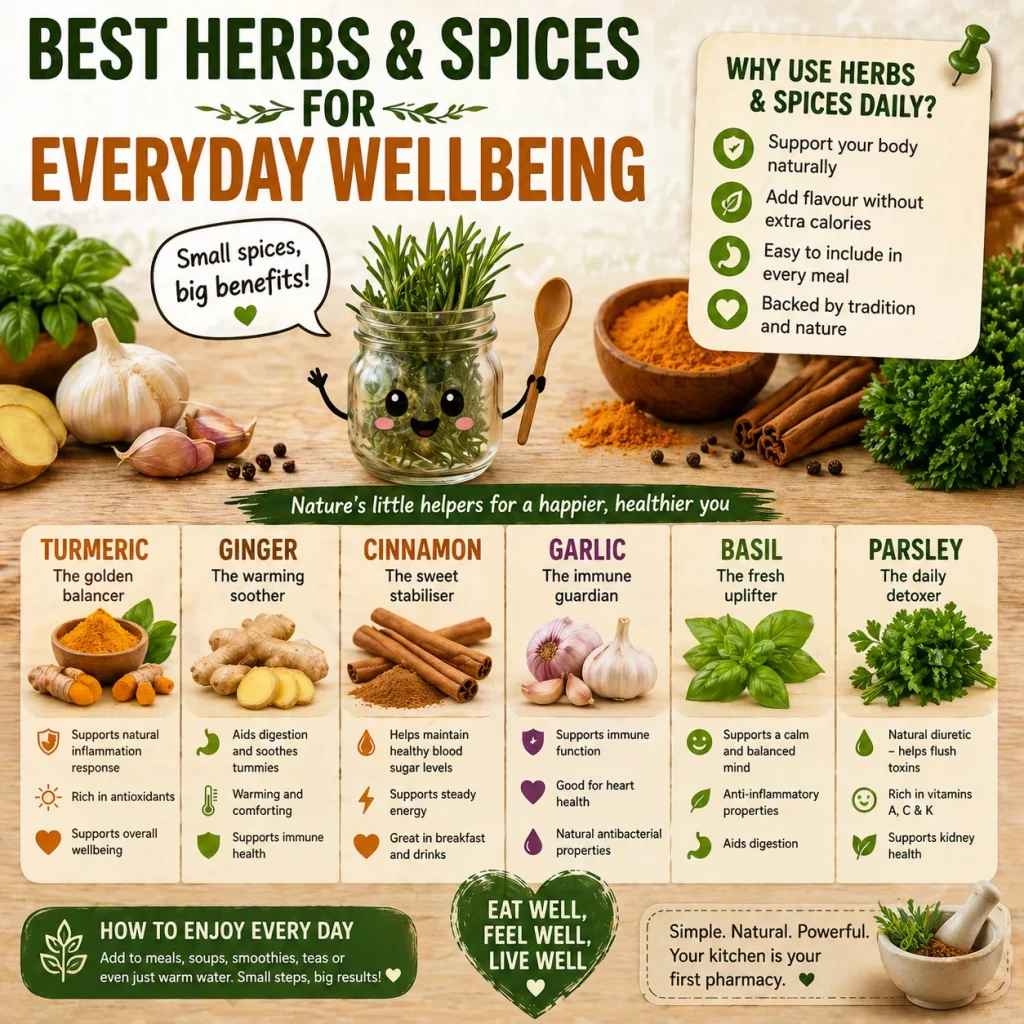
🌿 Best Herbs and Spices for Everyday Wellbeing
The best herbs and spices for everyday wellbeing are usually the ones you can actually use regularly.
You do not need twenty jars of exotic powders.
A handful of familiar ingredients such as ginger, turmeric, garlic, cinnamon, basil and parsley can add flavour, plant compounds and traditional herbal value to ordinary meals.
From a professional nutrition and herbal perspective, that is where I prefer to start: real food first, then look at what each herb or spice actually brings to the table.
🫚 Ginger
Ginger is one of the most useful all-round spices in the kitchen.
Ayurveda sees it as warming and stimulating to Agni, making it particularly useful when digestion feels cold, sluggish or heavy.
Nutritionally, ginger contains gingerols and shogaols, compounds that have been studied for their effects on digestion, inflammation and metabolic health.
Use fresh ginger in:
- Curries
- Soups
- Stir-fries
- Lentil dishes
- Herbal tea
Because it is strongly heating, someone with burning reflux or a lot of Pitta-type heat may need a gentler option.
🟡 Turmeric
Turmeric has been part of Ayurvedic practice and Indian cooking for centuries.
Its best-known compound is curcumin, although whole turmeric contains many other naturally occurring substances as well.
Modern research has explored curcumin for its effects on inflammatory signalling and oxidative stress, while Ayurveda traditionally uses turmeric around digestion, metabolism and stagnation.
Turmeric works easily in:
- Curries
- Rice
- Lentils
- Soups
- Egg dishes
- Vegetable stews
You do not need supplement-level doses for turmeric to have a useful place in the diet.
🧄 Garlic
Garlic sits somewhere between food and herb.
It contains sulphur compounds, including allicin, which have attracted research interest around cardiovascular, antimicrobial and immune-related effects.
From a traditional herbal point of view, garlic is warming, stimulating and strongly aromatic.
Ayurveda also treats it as a powerful herb rather than something that automatically suits everybody.
It works well in soups, sauces, stews, roasted vegetables and meat dishes.
🍂 Cinnamon
Cinnamon adds sweetness and warmth without adding sugar.
Its active compounds include cinnamaldehyde and various polyphenols.
Clinical research has looked particularly at cinnamon in relation to blood glucose and metabolic health, although results vary depending on the type of cinnamon, dose and study population.
Ayurvedically, cinnamon is warming and can suit colder, sluggish digestion.
Use it in:
- Porridge
- Stewed fruit
- Yoghurt
- Rice pudding
- Warm drinks
🌱 Basil
Basil tends to be overlooked because it feels too ordinary.
That is a mistake.
Basil provides aromatic compounds and polyphenols while also making simple food taste far better.
Fresh basil works beautifully with tomatoes, eggs, soups, pasta and vegetables.
Herbal practice also reminds us that food herbs do not have to be dramatic to be useful.
Sometimes the best herb is simply the one you eat regularly.
🌿 Parsley
Parsley is another everyday herb that deserves more credit.
It provides vitamin K, vitamin C, carotenoids and plant compounds such as apigenin.
Use it generously rather than treating one tiny sprig as decoration.
Parsley works well with:
- Potatoes
- Eggs
- Fish
- Beans
- Soups
- Salads
- Grain dishes
🔬 What the Research Says About Culinary Herbs and Spices
There is now a decent amount of research looking at culinary doses of common herbs and spices rather than only concentrated supplements.
A large scoping review covering 142 studies examined spices including cinnamon, ginger, garlic, turmeric, cumin, fennel, coriander and black pepper.
The strongest findings were not identical across every spice. Ginger, cinnamon, turmeric and several others showed promise in areas such as blood glucose control, blood lipids and inflammatory markers, although the researchers also pointed out that study quality and doses varied considerably.
Research on Culinary Herbs and Spices at Food-Level Doses
That is a far more useful way to look at the subject than claiming every spice “boosts health”.
Different plants contain different compounds and behave differently in the body.
🌿 Ayurveda Adds the Individual Back Into the Picture
One thing Ayurveda does particularly well is remind us that the same herb does not suit everybody in the same way.
Ginger and cinnamon bring warmth.
Turmeric is pungent and bitter.
Garlic is strongly heating and stimulating.
Someone who tends towards cold, sluggish digestion may respond very differently to those herbs than somebody already dealing with burning, irritation or excess Pitta.
That is why qualified herbal use is about more than making a list of “good herbs”.
We look at the person, their digestion, constitution, current state and the way the herb is being used.
🍽️ Keep It Simple
The easiest way to use the best herbs and spices for everyday wellbeing is through normal food.
Add ginger to a curry.
Use garlic in a stew.
Put cinnamon on porridge.
Throw parsley over potatoes.
Use turmeric in lentils.
Add fresh basil to tomatoes.
That gives you flavour, variety and a wider range of plant compounds without turning eating into a complicated wellness routine.
For a broader look at how we use herbs and spices in everyday health, read our Herbs and Spices for Wellbeing Natural Remedies from Body in Harmony Products.