
Calorie Dense Foods for Bulking – Natural Ways to Build Healthy Weight
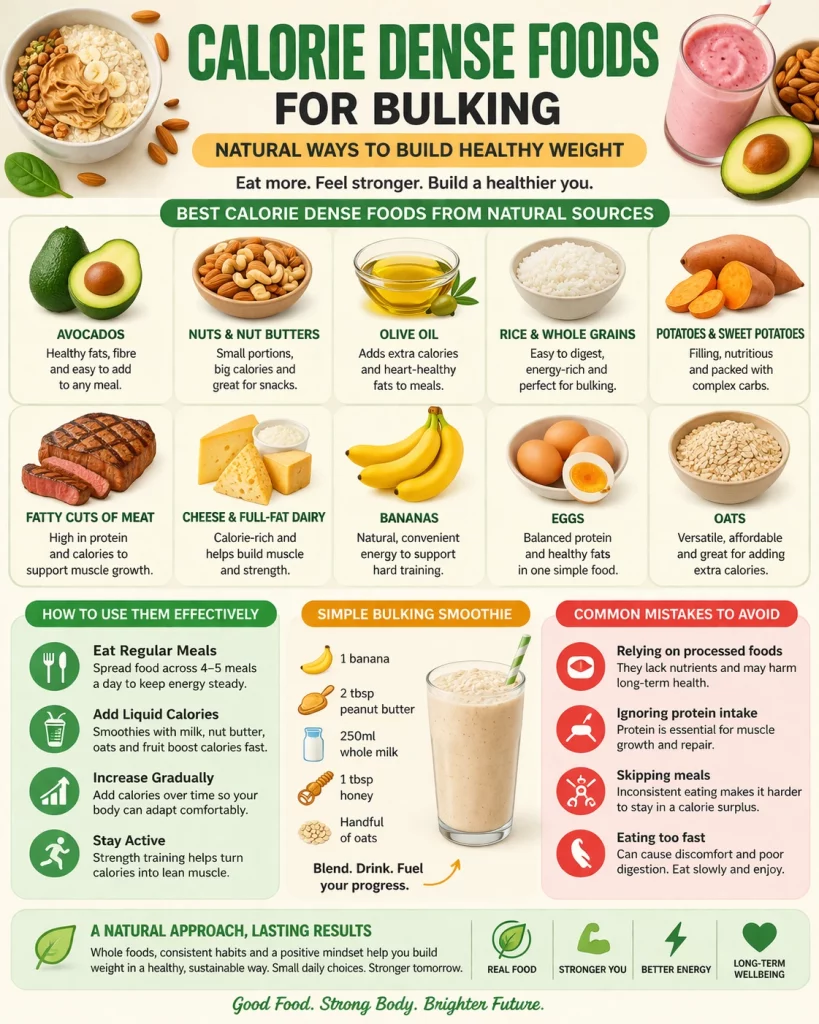
If you struggle to eat enough for weight gain, calorie dense foods for bulking can make the job much easier.
The problem is often food volume. You may know you need more calories, but another huge plate of food is the last thing you want.
The solution is to increase the amount of energy in the food you already eat.
🥑 Why Calorie Dense Foods for Bulking Work
Energy density simply means how many calories a food provides for its weight.
Fat provides around 9 calories per gram, while protein and carbohydrate provide around 4. This is why foods such as nuts, olive oil, avocado and full-fat dairy can add substantial calories without creating enormous meals.
Research into dietary energy density and energy intake shows that higher-energy-density foods can increase total calorie intake because more energy is packed into a smaller amount of food.
That is exactly what you want when appetite is the limiting factor.
🥜 Best Calorie Dense Foods for Bulking
You do not need specialist bulking powders.
Start with ordinary foods that combine calories with useful nutrients.
- 🥜 Nuts and nut butter
High in calories, unsaturated fats, protein and minerals. A spoonful of peanut or almond butter can quickly increase the energy content of oats or smoothies. - 🫒 Olive oil
One tablespoon provides roughly 120 calories. Add it to potatoes, pasta, rice or vegetables without greatly increasing meal volume. - 🥑 Avocado
Provides mainly monounsaturated fat alongside fibre, potassium and folate. - 🧀 Cheese and full-fat dairy
Useful sources of protein, calcium and additional calories where dairy is tolerated. - 🥚 Eggs
Provide complete protein alongside fat, vitamin B12, choline and other micronutrients. - 🍚 Rice, oats and other grains
Carbohydrate provides energy for training and helps replenish muscle glycogen. - 🥔 Potatoes and sweet potatoes
Useful carbohydrate sources that can easily be made more calorie-dense with olive oil, cheese or butter. - 🐟 Oily fish
Salmon, sardines and mackerel provide protein alongside omega-3 fats. - 🥩 Meat and poultry
Slightly fattier cuts can provide more calories than very lean alternatives while still supplying protein, iron and vitamin B12. - 🌰 Seeds
Pumpkin, sesame, sunflower, chia and flax provide concentrated calories, minerals and fats.
➕ Make Your Existing Meals More Calorie Dense
You do not necessarily need to eat another meal.
Take what you already eat and build on it.
For example:
- oats + whole milk + nut butter
- potatoes + olive oil + cheese
- rice + chicken thigh + avocado
- yoghurt + nuts + seeds
- eggs + avocado + toast
- pasta + minced beef + Parmesan + olive oil
Adding a tablespoon of oil, a handful of nuts or some cheese to several meals can increase daily intake considerably without doubling portion sizes.
The NHS uses the same basic principle in its guidance on healthy ways to gain weight, suggesting adults trying to gain weight gradually may start with around 300–500 additional calories per day and use foods such as cheese, nuts, seeds and high-calorie drinks.
🌿 An Ayurvedic Herbalist Perspective
Ayurveda traditionally looks beyond simply eating more.
If somebody has a poor appetite or regularly feels bloated and heavy after eating, continually forcing larger meals may not be particularly useful.
This is where Agni, the Ayurvedic concept of digestive capacity, comes in.
Traditionally, nourishing foods such as rice, oats, milk where tolerated, ghee, dates and nuts may be used when the aim is to build strength and body tissue. Warming spices such as ginger, cumin and cardamom are also commonly used alongside richer meals to support digestion.
That does not mean Agni is another name for digestive enzymes or metabolism. It is a traditional way of assessing how well someone handles and responds to food.
From my perspective, the practical lesson is straightforward: increase calories without making digestion miserable.
🥤 When Appetite Is Low
Liquid calories can be useful because they generally require less chewing and may feel easier than another large meal.
A simple weight-gain smoothie could contain:
- whole milk
- oats
- banana
- peanut butter
- yoghurt
For more combinations, see our high calorie smoothies for weight gain.
Keep drinks between meals if they tend to make you too full to eat.
💪 Bulking Means Giving the Calories Somewhere to Go
If your aim is muscle gain rather than simply increasing body weight, resistance exercise matters.
Training creates the stimulus for muscle adaptation. Dietary protein then supplies amino acids needed for repair and growth.
A meta-analysis of 49 resistance-training studies involving 1,863 participants found that additional dietary protein produced modest improvements in fat-free mass, muscle size and strength when combined with resistance training.
That is why a sensible bulk combines sufficient calories, adequate protein and progressive resistance exercise rather than simply eating everything in sight.
⚡ Keep Bulking Simple
Good calorie dense foods for bulking should make eating enough easier, not turn every meal into a challenge.
Start with normal food.
Increase portions gradually.
Use calorie-dense fats where useful.
Keep protein regular.
Add liquid calories when appetite is poor.
And if you need complete meal ideas rather than individual foods, see How to Naturally Gain Weight with Real Food Meals.