
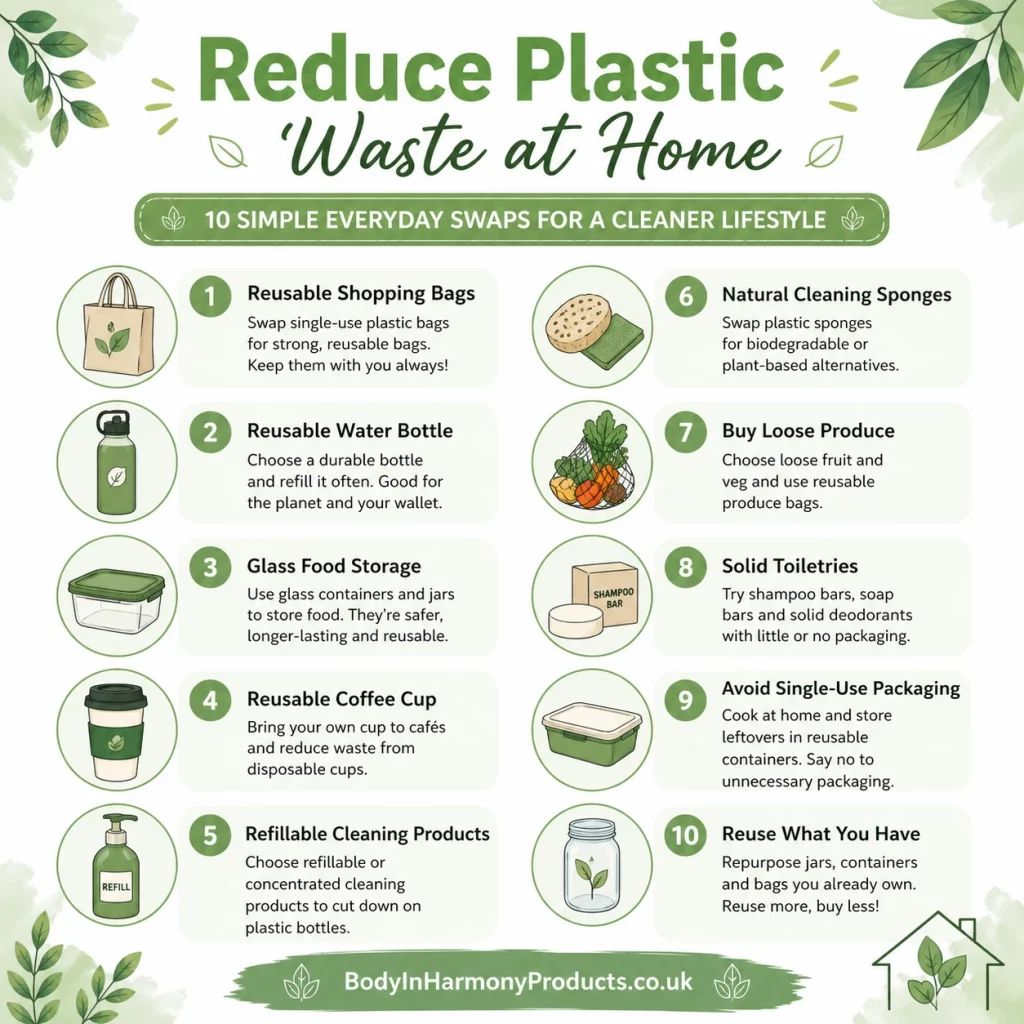
🌿 Reduce Plastic Waste at Home: 10 Simple Ways That Actually Work
You do not need to replace everything you own with expensive “eco” products to reduce plastic waste at home.
Most of the useful changes are much simpler.
Buy less disposable plastic, reuse what you already have, and replace single-use items only when there is a sensible alternative.
🛍️ 1. Keep Reusable Shopping Bags Handy
Buying reusable bags is pointless if they are always sitting in the kitchen when you reach the supermarket.
Keep a few:
- In the car
- Near the front door
- In your work bag
- Folded inside another shopping bag
The habit matters more than owning the perfect reusable bag.
🥤 2. Carry a Reusable Water Bottle
Bottled water creates plastic waste that is easy to avoid when safe drinking water is available.
A stainless-steel or reusable glass bottle can last for years.
Fill it before leaving home rather than buying another disposable bottle because you got thirsty halfway through the day.
🍱 3. Reuse Glass Jars and Containers
Before buying a matching set of fancy storage jars, use what you already have.
Glass jars from sauces, coffee and other foods can be cleaned and reused for:
- Dried herbs
- Rice
- Seeds
- Leftovers
- Homemade sauces
- Small kitchen ingredients
Glass food containers can also be useful when an old plastic container eventually needs replacing.
There is growing research into microplastic release from household products, including plastic food containers, scouring pads, synthetic textiles and other everyday materials.
Research on Household Sources of Microplastics
The human-health implications are still being investigated, so there is no need for scare stories.
Reducing unnecessary plastic use makes sense from a waste point of view regardless.
☕ 4. Take Your Own Coffee Cup
Many disposable takeaway cups contain a plastic lining.
If buying coffee out is part of your routine, carrying a reusable cup is an easy swap.
Some cafés offer a discount, but even when they do not, you are avoiding another cup and lid being thrown away after twenty minutes of use.
🧼 5. Try Refills and Concentrates
Cleaning products can generate a surprising pile of empty bottles.
Look for:
- Refill stations
- Refill pouches where they genuinely use less material
- Concentrated products
- Larger containers for products you use regularly
Do not throw away half-full cleaning products simply because you have decided to become more sustainable.
Use them first.
Reduce plastic waste at home. Creating waste in order to buy an eco-friendly replacement rather defeats the point.
🧽 6. Replace Worn Plastic Sponges Sensibly
Some synthetic kitchen sponges and scouring products can release plastic fibres and particles as they wear down.
When yours genuinely needs replacing, consider:
- Cellulose cloths
- Natural-fibre brushes
- Washable cotton cloths
- Other durable reusable alternatives
Again, use what you already own before replacing it.
🥕 7. Buy Loose Produce When It Makes Sense
A cucumber wrapped in plastic has become almost a symbol of unnecessary packaging.
Choose loose fruit and vegetables where practical, particularly when you only need one or two items.
That can also help reduce food waste because you buy the amount you actually need rather than whatever quantity happens to be inside the packet.
🧴 8. Look at Solid Toiletries
Soap bars are an easy place to start.
Shampoo bars and other solid toiletries can also reduce packaging if you find products that genuinely work for you.
There is no point buying five different zero-waste toiletries that sit unused in the bathroom because you hate them.
Change products gradually as the old ones run out.
🥡 9. Cut Back on Single-Use Food Packaging
Takeaways, ready meals and individually wrapped snacks can generate plenty of plastic.
Cooking more often gives you greater control over both the food and the packaging.
For leftovers, use reusable containers rather than automatically reaching for cling film.
When shopping, compare products too.
Sometimes exactly the same food is available in a cardboard box, glass jar or larger pack that produces considerably less packaging per serving.
🔄 10. Reuse Before You Buy Something New
This is probably the most important habit on the list.
Sustainability has become an industry of its own, and it is very easy to end up buying loads of new products to prove how environmentally friendly you are.
Before buying anything, ask:
Do I already own something that can do this job?
Old jars can become storage.
Existing shopping bags can be reused dozens of times.
Takeaway containers can sometimes be reused for non-heated storage.
Boxes can organise cupboards.
The most sustainable purchase is often the one you do not make.
♻️ Start With the Plastic You Use Most
If you want to reduce plastic waste at home, look in your own bin.
That tells you where to start.
If it is full of bottled drinks, tackle those.
If most of the plastic comes from food packaging, change how you shop.
If toiletries create most of it, look at refills or solid products as they run out.
There is no need to become plastic-free overnight.
Reduce the obvious waste first and build from there.
For more practical swaps, read our Plastic-Free Alternatives for Everyday Living from Body in Harmony Products.