
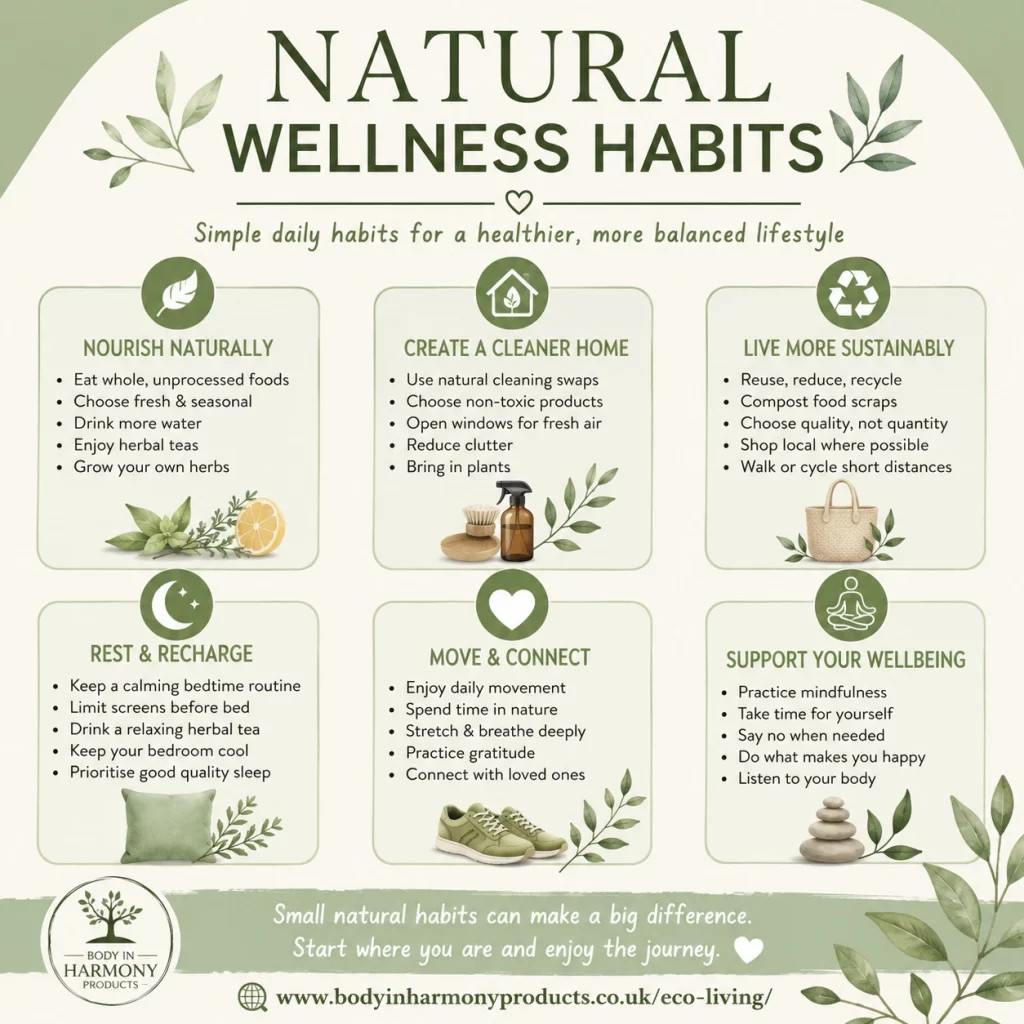
🌿 Natural Wellness Habits for Everyday Life
Natural wellness habits do not need to involve expensive supplements, complicated routines or replacing everything in your house overnight.
From a nutrition and herbal wellbeing perspective, I would rather see somebody improve a handful of everyday habits they can actually maintain.
What you eat, how you sleep, how much you move, the amount of daylight you get and the environment you spend your time in all influence how you feel.
Start there.
🍋 Make the Kitchen a Better Place to Begin
Food is one of the easiest areas to improve because you make choices around it every day.
Keep things simple:
- Cook with fresh ingredients regularly
- Eat plenty of vegetables and fruit
- Use herbs and spices for flavour
- Reduce reliance on ultra-processed food
- Store food sensibly in glass where practical
- Grow a few herbs if you have the space
- Drink water regularly rather than relying on sugary drinks
Fresh rosemary, parsley, basil, mint and thyme do more than make food taste better.
They contain naturally occurring plant compounds, while stronger spices such as ginger, turmeric and cumin also have long histories in traditional herbal and Ayurvedic cooking.
As a nutritionist, I am interested in what the meal provides.
As a herbalist, I am also interested in how herbs, spices and preparation methods can support digestion and make good food more enjoyable.
The two approaches fit together naturally.
🧼 Keep the Home Simple Rather Than Chemical-Free
You will often hear people talking about creating a completely “non-toxic home”.
That phrase can become misleading very quickly.
Everything is made from chemicals, including water.
A more sensible goal is to reduce unnecessary exposure to strongly fragranced or irritating products where you have an easy alternative.
For everyday jobs, that might mean:
- Using plain soap and water where it does the job
- Using bicarbonate of soda for certain cleaning jobs and odours
- Using vinegar where it is suitable for the surface
- Choosing simpler fragrance-free products if scents irritate you
- Opening windows when outdoor air quality allows
- Avoiding buying ten products when two will do
Natural does not automatically mean harmless either.
Essential oils are highly concentrated plant extracts and can irritate skin, airways or pets when used carelessly.
Herbal knowledge means respecting the strength of natural substances, not assuming anything from a plant is automatically safe.
🌱 Eco Living Without Turning It Into a Religion
Eco living works better when it fits normal life.
Reuse what you already own before buying an expensive “eco” replacement.
Walk short journeys when practical.
Compost suitable food scraps if you have somewhere to use the compost.
Buy durable products instead of repeatedly replacing cheap disposable ones.
Grow a little food if you have room.
None of those changes is dramatic on its own.
Together, they reduce waste and encourage a less disposable way of living.
🌙 Protect Your Sleep
Sleep is one of the most useful natural wellness habits and somehow one of the easiest to neglect.
The body works around a roughly 24-hour circadian rhythm influenced strongly by light and darkness.
That means your morning and evening routines matter.
Try:
- Getting natural daylight earlier in the day
- Keeping evenings calmer
- Dimming bright lights later at night
- Reducing endless phone scrolling before bed
- Avoiding enormous late meals if they disturb your sleep
- Keeping the bedroom reasonably cool and dark
Herbal teas can also become part of an evening routine.
Chamomile, lemon balm or tulsi may suit some people, although the herb should still match the individual rather than being treated as a guaranteed sleeping remedy.
Ayurveda has always placed importance on Dinacharya, or daily routine.
Modern life has changed enormously, but the basic idea that the body responds well to reasonably consistent rhythms still makes a lot of sense.
🥗 Let Food Do Most of the Heavy Lifting
A healthy lifestyle does not require a cupboard full of powders.
Build meals around:
- Vegetables and fruit
- Eggs, fish, meat, dairy or plant proteins
- Whole grains and potatoes
- Beans and lentils
- Nuts and seeds
- Olive oil and other useful fats
- Herbs and spices
There is room for convenience food.
The problem comes when heavily processed food becomes the foundation of the diet rather than the occasional shortcut.
Ayurveda adds another useful question:
How well are you digesting what you eat?
A food can look perfect on paper and still leave somebody bloated, heavy or uncomfortable.
That is why we look at Agni, appetite, digestion and individual constitution alongside nutrient content.
Healthy eating has to work for the person eating it.
🚶 Get Outside and Move
You do not need to turn exercise into punishment.
Walk.
Garden.
Stretch outside.
Take the long way home occasionally.
Spend some time somewhere green without staring at a screen.
Research examining nature exposure has found associations with improved mental health, cognitive function, physical activity and sleep, although researchers also point out that the type and amount of exposure still need further study.
Nature Exposure and Health Research
That fits something people have understood instinctively for generations.
We tend to feel different after spending time outside compared with sitting under artificial light looking at screens all day.
🌿 Build Habits You Can Actually Keep
You do not need twenty new rules.
Choose a few things that make sense:
- Cook more often
- Use herbs and spices regularly
- Get outside every day
- Walk more
- Protect your sleep
- Reduce unnecessary household products
- Buy less disposable rubbish
- Give yourself some quiet time
Those are natural wellness habits because they bring everyday life back towards food, movement, rest, nature and sensible routine.
Nothing mystical is required.
For more simple ideas around sustainable living, visit the Eco Living section from Body in Harmony Products.