
🌸 Restore Natural Balance: Reconnect Mind, Body and Health
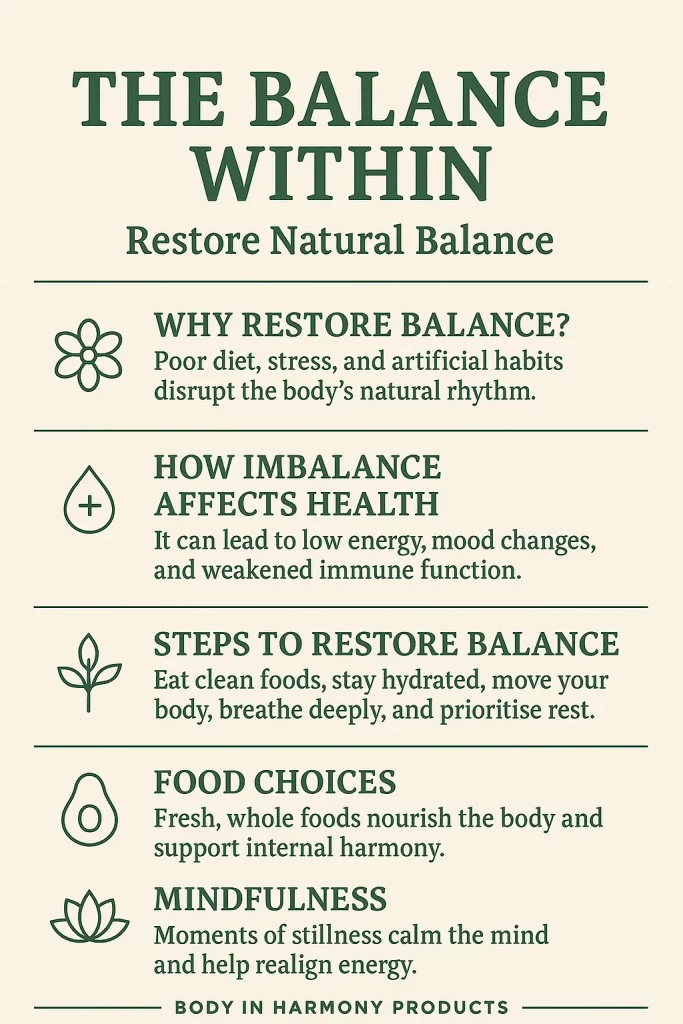
To restore natural balance, start with the basics your body responds to every day: food, light, movement, sleep and stress.
Modern routines can easily disrupt those patterns. Late nights, constant stimulation, irregular meals and very little daylight can affect energy, mood, appetite and sleep.
As a qualified Diet and Nutritional Advisor and practitioner of Ayurvedic Herbalism, I prefer to look at balance as something built through daily habits rather than something achieved with a quick detox.
🌙 Why Your Natural Rhythm Matters
Your body runs on a roughly 24-hour internal timing system known as the circadian rhythm.
Light entering the eyes helps synchronise this clock, which influences sleep, alertness, hormone timing and metabolism.
Research on circadian health shows that persistent disruption of these rhythms can affect sleep, metabolic function and mental wellbeing.
Read the research on sleep, circadian rhythms and health
🌿 Simple Ways to Regain Balance Naturally
You do not need an extreme cleanse or complicated routine.
Start with:
- regular sleep and waking times
- daylight exposure during the morning
- daily walking or gentle movement
- enough water
- mostly whole, minimally processed food
- regular breaks from screens and stimulation
- time outside where possible
These habits support the systems already responsible for recovery, energy regulation and normal metabolic function.
For more practical ideas, see our guide to Daily Wellbeing: Simple Habits for Everyday Health.
🥑 Food and Metabolic Balance
Food affects blood glucose, digestion, hormones and energy production.
Fruit, vegetables, whole grains, pulses, nuts, seeds, herbs and good-quality protein provide the nutrients needed for those processes.
Highly processed food does not “confuse” your cells, but a diet dominated by refined carbohydrates, excess salt and low-fibre foods can make maintaining steady energy and good metabolic health more difficult.
The goal is not perfection.
It is a consistent eating pattern your body can work with.
🧘 Stress, Mindfulness and the Nervous System
How to restore Natural Balance. Stress is not just something you feel mentally.
When the brain detects pressure or threat, the sympathetic nervous system becomes more active and hormones such as adrenaline and cortisol rise.
That response is useful in short bursts.
Problems arise when the body spends too much time in that heightened state without enough recovery.
Walking, slow breathing, meditation, Tai Chi and quiet time can all help shift the nervous system towards a calmer state.
If you are interested in the relationship between nature and relaxation, our guide to Grounding on Grass explores that subject in more detail.
🌿 An Ayurvedic View of Balance
Ayurveda has always placed strong emphasis on rhythm.
Daily routine, known as Dinacharya, traditionally considers sleep, meals, movement and other habits as part of maintaining balance.
This is an Ayurvedic framework rather than modern biomedical physiology, but there is an interesting overlap with what we now understand about regular sleep-wake cycles and meal timing.
Both recognise that the body responds to consistency.
🌞 The Bottom Line
You do not need to overhaul your life to restore natural balance.
Regular sleep, daylight, movement, nourishing food and periods of genuine rest can make a noticeable difference to how steady your energy and mood feel.
Think less about forcing the body to “detox” or reset.
Give it the conditions it needs to regulate itself properly, then let consistency do the work.
For more gentle everyday ideas, see Daily Rituals for Balance and Calm.