
🌿 The Five Elements of Ayurveda: A Simple Beginner’s Guide
The five elements of Ayurveda are one of the foundations for understanding how Ayurveda looks at the body, food, nature and the three doshas.
You may have heard them described as Earth, Water, Fire, Air and Ether.
They sound mysterious at first, but the basic idea is actually very simple.
Ayurveda uses these elements to describe different qualities and functions found throughout nature and within us.
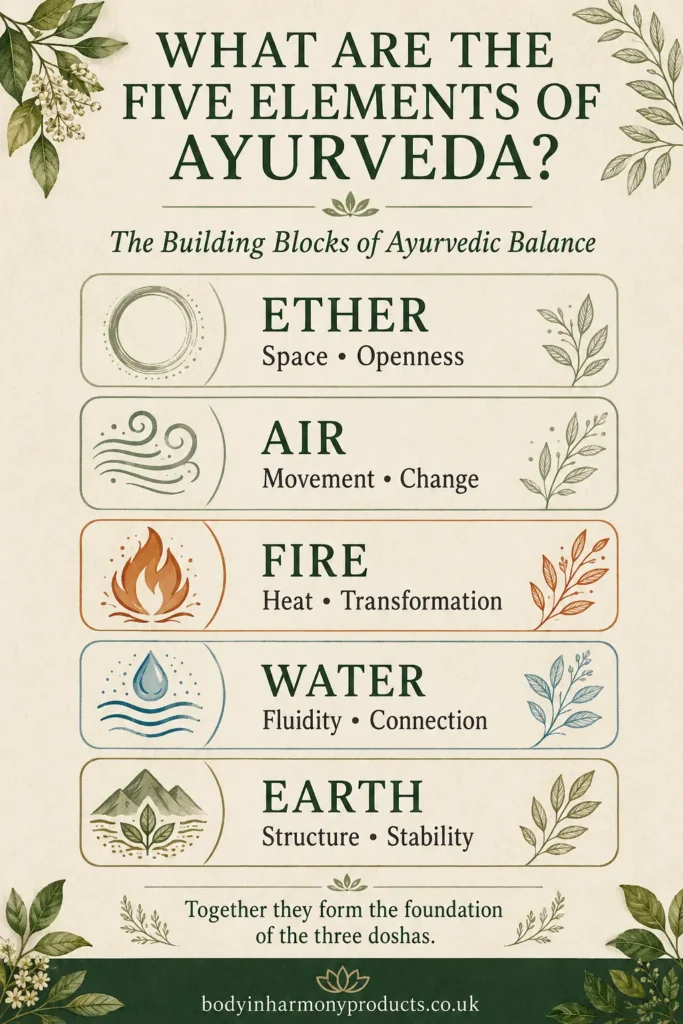
The five elements are:
- 🌍 Earth – Prithvi: structure and stability
- 💧 Water – Jala: moisture and flow
- 🔥 Fire – Tejas or Agni: heat and transformation
- 💨 Air – Vayu: movement
- ✨ Ether – Akasha: space
Once you understand those five ideas, Vata, Pitta and Kapha make much more sense.
I have put together a FREE guide to the basics of Ayurveda that you will find beneficial. Just put your email into the box below and I will send it straight to your inbox.
🌍 Earth – Structure and Stability
Earth represents what is solid, dense and stable.
The easiest way to understand it is to think about structure.
Bones, muscles and other physical tissues give the body substance and support.
Within Ayurvedic thinking, Earth is associated with qualities such as:
- Stability
- Heaviness
- Strength
- Solidity
- Grounding
It is not saying that your bones are literally made from soil.
Earth is a way of describing the solid and structural qualities present in the body and nature.
That distinction is worth understanding from the beginning.
💧 Water – Moisture and Flow
Water represents fluidity, moisture and cohesion.
This one is easy to picture because fluids are everywhere in the body.
Blood, digestive secretions, saliva and the fluid surrounding our tissues all depend on moisture.
Ayurveda associates the Water element with qualities such as:
- Moisture
- Flow
- Softness
- Coolness
- Cohesion
Water also combines with other elements when the doshas are formed.
We see it particularly strongly in Kapha and as a supporting element within Pitta.
🔥 Fire – Heat and Transformation
Fire represents transformation.
Digestion is the obvious example.
Food goes into the digestive system and has to be broken down, transformed and used by the body.
Ayurveda describes digestive power as Agni, commonly translated as digestive fire.
Fire is associated with:
- Heat
- Digestion
- Transformation
- Metabolism
- Sharpness
The important word here is transformation.
Whenever Ayurveda talks about something being changed from one state into another, Fire is usually part of the explanation.
💨 Air – Movement
Air represents movement.
Think about everything in the body that has to move.
Breathing moves air in and out of the lungs. Food moves through the digestive tract. Nerve signals travel through the body and muscles create physical movement.
Ayurveda uses the Air element to describe qualities such as:
- Movement
- Lightness
- Dryness
- Mobility
- Change
Air combines with Ether to form Vata, which is why Vata is so strongly associated with movement.
✨ Ether – Space
Ether, or Akasha, is usually the element beginners find hardest to understand.
The easiest translation is simply space.
Movement cannot happen unless there is somewhere for it to happen.
Think about the mouth, digestive tract, blood vessels and other cavities within the body.
Ayurveda uses Ether to represent openness, lightness and the spaces in which other processes take place.
Ether is associated with:
- Space
- Openness
- Lightness
- Expansion
Together, Ether and Air form Vata.
⚖️ How the Five Elements Form the Doshas
This is where the five elements of Ayurveda start fitting together.
According to traditional Ayurvedic theory:
- 💨 Vata = Ether + Air
- 🔥 Pitta = predominantly Fire + Water
- 🌍 Kapha = Earth + Water
Those combinations help explain the characteristics given to each dosha.
Vata contains Air and Ether, so movement, lightness and change are central to it.
Pitta is dominated by Fire, so heat, digestion and transformation are major qualities.
Kapha contains Earth and Water, giving it heavier, slower and more stable qualities.
Rather than trying to memorise twenty characteristics for each dosha, understanding the elements underneath them makes the whole system easier to remember.
🌿 Why the Five Elements Matter in Ayurveda
As Ayurvedic practitioners, we are not learning the five elements simply as an interesting bit of ancient philosophy.
They provide a framework for understanding many other areas of Ayurveda, including:
- The three doshas
- Agni and digestion
- Food qualities
- Herbs and spices
- Seasonal changes
- Daily routines
- Prakriti and constitution
- Patterns of imbalance
For example, somebody displaying lots of dry, cold and changeable qualities may be showing characteristics traditionally associated with Vata.
Someone displaying excessive heat and sharpness may show more Pitta qualities.
It gives us a language for recognising patterns.
That is one reason Ayurveda looks at the whole person rather than reducing everything to a single symptom.
🔬 What Does Modern Research Say About the Five Elements?
This part needs to be understood properly.
Earth, Water, Fire, Air and Ether in Ayurveda are not scientific chemical elements.
They belong to the traditional philosophical and medical framework known as Pancha Mahabhuta, meaning the five great elements.
Academic reviews of Ayurveda describe these five elements as the basis from which the traditional three-dosha model develops.
For example, a review of the history and principles of Ayurveda explains how Vayu, Jala, Akasha, Prithvi and Teja form the traditional foundation of Vata, Pitta and Kapha.
You can read the full academic overview here:
The History and Principles of Ayurveda
That does not mean modern science has proved that the human body is literally composed of five Ayurvedic elements.
It means researchers studying Ayurveda recognise the five-element model as a central part of the traditional system.
🔗 Where to Go Next
If you are learning Ayurveda, keep these five ideas in your head:
Earth gives structure.
Water provides moisture and flow.
Fire transforms.
Air moves.
Ether provides space.
Then start looking at how those qualities appear within Vata, Pitta and Kapha.
That is far easier than trying to memorise Ayurveda as a huge list of Sanskrit words.
For a broader explanation, read our Beginner’s Guide to Ayurveda from Body in Harmony Products.
You can also type bihp.co.uk into your browser.
I have put together a FREE guide to the basics of Ayurveda that you will find beneficial. Just put your email into the box below and it is yours to keep forever.